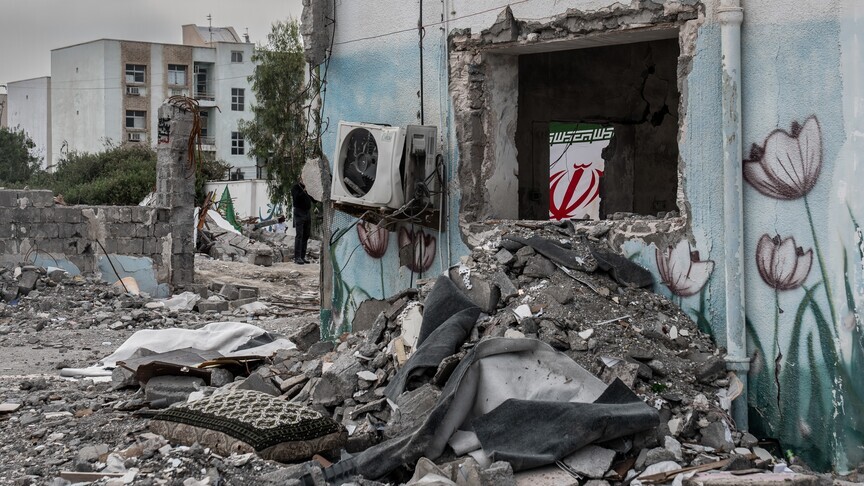
The top Democrat on the House Armed Services Committee pressed the CENTCOM chief on Tuesday for answers about a strike that killed more than 150 girls at an Iranian school on Feb. 28.
During a US House committee hearing on US posture in the "Greater Middle East and Africa" Rep. Adam Smith urged Adm. Brad Cooper to acknowledge US responsibility for the strike on the school, which Iranian officials say killed 175 people, including more than 150 schoolgirls.
“It’s really pretty clear what happened there,” Smith said, noting that in previous incidents the US military has moved quickly to acknowledge mistakes even while investigations were still ongoing.
“Can you, at this moment, acknowledge that that mistake was made, and that we were responsible for it? It’s something we didn’t want to do, and don’t want to repeat?” Smith asked.
Cooper declined to take responsibility, saying only: “The United States does not deliberately target civilians.”
“Nor are the Iranian people our enemy. The IRGC is the adversary in this case,” he added.
“Admiral, I asked you a very specific question, and I’m curious what the answer is,” Smith said.
“The investigation is ongoing,” Cooper replied.
Cooper said the school is located near an active IRGC (Iran’s Islamic Revolutionary Guard Corps) cruise missile base, making the incident “more complex than the average strike,” and pledged transparency once the investigation concludes.
Smith responded: “I do not trust that answer. What we’ve seen out of this Secretary of Defense (Pete Hegseth) and his callous disregard for any sort of rules of engagement or protecting civilian life may make us suspicious.”
He added that the administration’s refusal to acknowledge potential errors is “precisely the reason we are in the hole that we’re in with no way out.”
The Feb. 28 strike on Shajareh Tayyebeh Elementary School in Minab killed approximately 175 people, according to Iranian officials.
Several US media outlets have reported, citing preliminary US assessments, that the school may have been struck by an American Tomahawk missile.
Preliminary findings
Rep. Sara Jacobs, another Democrat, also pressed the CENTCOM chief on the school strike, telling Cooper that she, in a letter signed by more than half the Democratic caucus members, requested more information about the Minab attack and demanded that the ongoing investigation be made public.
Asked if he could confirm whether the New York Times report, which said the preliminary inquiry concluded that the strike is the US' fault, Cooper did not deny or confirm.
"I immediately directed a more sophisticated, comprehensive investigation that would be led by an outside organization," said Cooper. "That is in progress. We're coming toward the end of it."
Cooper separately said his staff reviewed all 39 incidents outlined in a separate New York Times report on schools struck during the war, and determined only one, the Minab girls' school, correlated with a US strike; the other 38 "did not involve US munitions."
Democratic Rep. Seth Moulton noted President Donald Trump's remarks demanding "unconditional surrender" from Tehran. "Is that part of the plan?” he asked.
"Congressman, we achieved all of our military objectives," Cooper responded. "We are presently in a ceasefire, we’re executing a blockade, and we’re prepared for a broad range of contingencies."
Moulton then asked, "It doesn't seem to be going well, and I would like to know how many more Americans we have to ask to die for this mistake. Do you know?”
"I think it's an entirely inappropriate statement from you, sir," Cooper responded.
When pressed by other lawmakers on whether the war with Iran is over, Cooper responded by saying, "We have a ceasefire."
Lawmakers also challenged Cooper on reports that Iran has already reconstituted many of its bombed-out missile sites. Cooper rejected the claims. "Those reports are inaccurate," he said.
The hearing comes as regional tensions have escalated since the US and Israel launched strikes against Iran in late February. Tehran retaliated with strikes targeting Israel, as well as US allies in the Gulf, including the United Arab Emirates, along with the closure of the Strait of Hormuz.
A ceasefire took effect April 8 through Pakistani mediation, but talks in Islamabad failed to produce a lasting agreement. US President Donald Trump later extended the truce indefinitely.