Anadolu Ajansı © 2026


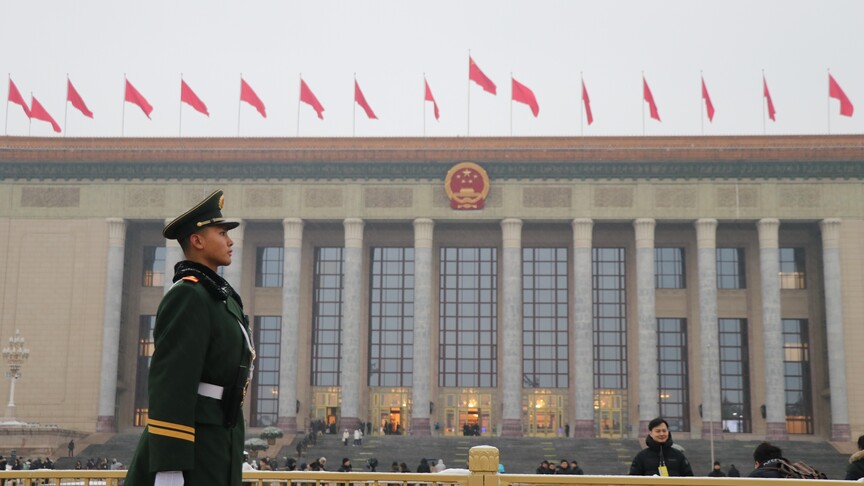
China’s recent diplomatic outreach involving the top leaders of the US, Russia, the European Union and the Global South in rapid succession reflects what analysts describe as a deliberate effort by Beijing to redefine the meaning of global leadership in an increasingly fragmented international order.
Over the past year, Beijing has hosted a series of high-level diplomatic engagements involving rival geopolitical camps, underscoring China’s attempt to position itself at the center of multiple power networks simultaneously.
Russian President Vladimir Putin visited China in May 2024 on his first foreign trip after beginning another presidential term, reaffirming Moscow’s deepening strategic partnership with Beijing as the Kremlin continued to grapple with the fallout from the war in Ukraine.
European leaders, including French President Emmanuel Macron and European Commission President Ursula von der Leyen, also traveled to Beijing in 2024 as both sides sought to manage tensions over trade, electric vehicles and market access while preserving broader economic ties.
The diplomatic push accelerated further this month when US President Donald Trump visited Beijing from May 13-15 for talks with Chinese President Xi Jinping focused on trade, Taiwan, Iran and broader strategic stability between the world’s two largest economies.
Analysts said the sequencing of those engagements was significant. As Washington remains preoccupied with instability in the Middle East and Moscow struggles under the burden of the Ukraine war, Beijing is increasingly presenting itself as a stable and predictable diplomatic actor capable of engaging rival powers simultaneously.
Einar Tangen, a Beijing-based geopolitical analyst and senior fellow at the Waterloo-based think tank Center for International Governance Innovation, said much of China’s growing diplomatic leverage stems from the “strategic missteps of competing powers.”
“Much of what Beijing is gaining comes from the strategic mistakes of others,” Tangen told Anadolu. “Own goals do not constitute an opposition strategy.”
Perils of transactional diplomacy
Tangen said the US has weakened parts of its global credibility through what he described as increasingly transactional diplomacy and inconsistent strategic messaging.
“The United States has damaged parts of its credibility through increasingly transactional diplomacy, inconsistent signaling, and the perception that domestic politics now drives foreign policy more than long-term strategy,” he said.
He added that Trump’s handling of the Iran conflict had reinforced concerns among allies and middle powers about unpredictability in American decision-making, while Russia’s prolonged difficulties in Ukraine had diminished Moscow’s image as a decisive strategic actor.
Unlike the ideological binaries that defined the Cold War, Beijing has largely avoided overt bloc politics even as it expands influence across competing camps. Sahab Enam Khan, a professor of international relations at Jahangirnagar University in Bangladesh, said China’s outreach reflects a “deeper strategic calculation rather than simple diplomatic opportunism.”
“Beijing is not attempting to replace Washington or rescue Moscow,” Khan told Anadolu. “It is calmly positioning itself as the transaction-enabling pole in an increasingly unreliable order.”
Khan argued that the West’s limited ability to contain instability in the Middle East, combined with Russia’s growing dependence on China amid the Ukraine conflict, has created “a vacuum not of power, but of reliability.”
That distinction has become increasingly central to Beijing’s diplomatic positioning.
China is not claiming ideological supremacy in the manner Washington once framed liberal internationalism, nor is it openly constructing a rigid anti-Western alliance structure.
Instead, analysts say Beijing is cultivating an image of flexibility — a power open to trade, mediation and long-term economic partnership regardless of political alignment.
For countries across Asia, Africa and Latin America, particularly those frustrated with sanctions-driven diplomacy and geopolitical polarization, that posture has gained increasing appeal.
'Performance of optionality'
Khan described China’s balancing strategy as a calculated “performance of optionality.”
“Xi’s successive hosting of American, European, Russian and Global South interlocutors is less a bid for hegemony than a deliberate performance of optionality,” he said. “Beijing is signaling that it can do business with everyone precisely because it is aligned exclusively with none.”
Tangen meanwhile said the significance of Trump and Putin visiting Beijing within days of each other went beyond diplomatic symbolism.
“That is why both Trump and Putin traveled to Beijing within days of each other,” he said. “The significance was not ceremonial. It demonstrated that China has become an unavoidable geopolitical convergence point capable of engaging rival power centers simultaneously on separate tracks.”
According to Tangen, Beijing has deliberately avoided triumphalism over Western or Russian setbacks in order to prevent the emergence of broader balancing coalitions against China.
“Beijing’s strategy is calibrated,” he said. “It understands that celebrating American or Russian difficulties would accelerate balancing coalitions against China. Instead, it presents itself as patient, predictable, economically central, and diplomatically available.”
“The larger shift is structural,” Tangen added. “Global influence today is less about imposing ideological leadership and more about being an indispensable power others must engage regardless of their rivalries.”
The approach has also allowed China to appear comparatively restrained amid widening global instability. The wars in Ukraine and Gaza, broader tensions across the Middle East and escalating trade disputes have reinforced perceptions that the existing international order is struggling to maintain coherence.
Andrea Ghiselli, a lecturer in international politics at the UK-based University of Exeter, said Beijing’s diplomatic outreach is fundamentally aimed at “projecting reliability.”
“China is trying to position itself as a source of international stability — a reliable and predictable partner,” Ghiselli told Anadolu. “The main target of its actions, of course, is Washington rather than Moscow.”
Lacking operational depth?
Yet analysts also note the limits of Beijing’s ambitions. Despite portraying itself as a potential mediator in global conflicts, China has largely avoided assuming the political risks associated with direct conflict resolution.
Ghiselli said Chinese peace initiatives have often lacked operational depth.
“Chinese leaders and officials have put forward peace proposals,” he said, “but they generally lack concrete implementation mechanisms.”
That tension continues to shape China’s foreign policy. Beijing seeks the prestige associated with stability and peacemaking while avoiding the costly commitments traditionally associated with global leadership.
China’s 12-point position paper on Ukraine was criticized by several Western governments as politically vague, while Beijing’s calls for de-escalation in the Middle East have stopped short of direct mediation efforts.
Even so, analysts say symbolism itself has become an important form of geopolitical influence in an increasingly fractured global environment.
That logic partly explains the significance surrounding reports of a possible Xi visit to North Korea in the coming months. Such a trip, said analysts, would reinforce China’s role as a central manager of regional stability in Northeast Asia while signaling Beijing’s enduring leverage over one of the world’s most sensitive security flashpoints.
More broadly, China’s diplomatic offensive reflects ambitions extending beyond economic power. Beijing increasingly seeks recognition as a central actor in shaping a multipolar international system rooted less in ideological blocs than in transactional influence, economic interdependence and strategic flexibility.
Whether that framework evolves into genuine multipolarity or what Khan described as “a softer Sinocentrism” remains uncertain.
“The risk,” Khan warned, “is that steadiness hardens into indispensability, and transactional multipolarity quietly tips into a softer Sinocentrism.
news_share_descriptionsubscription_contact