Ali Canberk Ozbugutu and Emir Yildirim
09 July 2026•Update: 09 July 2026
- Declining Strait of Hormuz traffic, Trump’s sharp remarks pressure European and Asian stock markets
Global markets are trading mixed as renewed tensions in the Middle East fuel inflation concerns, while minutes from the US Federal Reserve's latest meeting highlight risks that could warrant a hawkish policy stance.
The sustainability of peace in the Middle East was called into question amid renewed military exchanges between the US and Iran, leading to growing geopolitical risk perception in the markets.
US President Donald Trump said the ceasefire with Iran is over and that he no longer wishes to deal with Tehran. US Central Command announced it carried out an additional round of strikes against Iran targeting around 90 military targets.
Trump recently said Iran wants to reach a deal with the US, somewhat easing geopolitical concerns but the negative effects influencing market pricing have become more pronounced.
Brent crude oil reached $80 per barrel on Wednesday for the first time since June 22 amid these developments, while the number of tankers passing through the Strait of Hormuz dropped to seven on the same day, marking a massive drop versus 14 vessels the previous day.
Analysts say tanker transit data may be ambiguous as some ships turned their signaling systems off.
Fed rate hike expected
Meanwhile, the Fed minutes released Wednesday showed most of the bank officials say a rate hike may be needed if inflation continues to remain high amid strong demand driven by artificial intelligence (AI), the Middle East war, or the impact of tariffs.
All Fed officials supported the current policy rate range at the last meeting, while arguing that strong AI demand was among the factors keeping inflation high, according to the minutes.
At the same time, the International Monetary Fund (IMF) lowered its global economic growth forecast for 2026 from 3.1% to 3% in its updated World Economic Outlook report, while noting the Turkish economy is expected to grow 2.9% this year and 3.6% in 2027.
In light of these developments, the US 10-Year Treasury yield rose 2 basis points to 4.58% on Wednesday, while trading sideways on Thursday.
Gold falls
Gold fell 0.7% on Wednesday to $4,077 per ounce amid rising oil prices fueling inflation and growing hawkish expectations by central banks, extending its decline into the third trading day. Gold started Thursday down 0.3% at $4,067 per ounce.
The US Dollar Index is trading flat at 100.9 and Brent crude oil is down 0.5% at $78.2 per barrel on Thursday.
The S&P 500 fell 0.28% and the Dow Jones 1.09%, while the Nasdaq rose 0.2% on Wednesday. American indexes opened Thursday on a positive note.
European stock markets negative
European stock markets were negative on Wednesday amid renewed Middle East tensions and Trump’s remarks dampening risk appetite, alongside rising oil prices, which drove energy company stocks.
Trump said he no longer wishes to work with Spain, driving down the country IBEX 35 index, while bond yields in the region rose amid expectations that the Bank of England (BoE) will hike rates once by year-end.
The UK's FTSE 100 fell 1.66%, France's CAC 40 2.18%, Germany's DAX 40 2.23%, and Italy's FTSE MIB 30 1.22% on Wednesday. European indexes started Thursday on a positive trend.
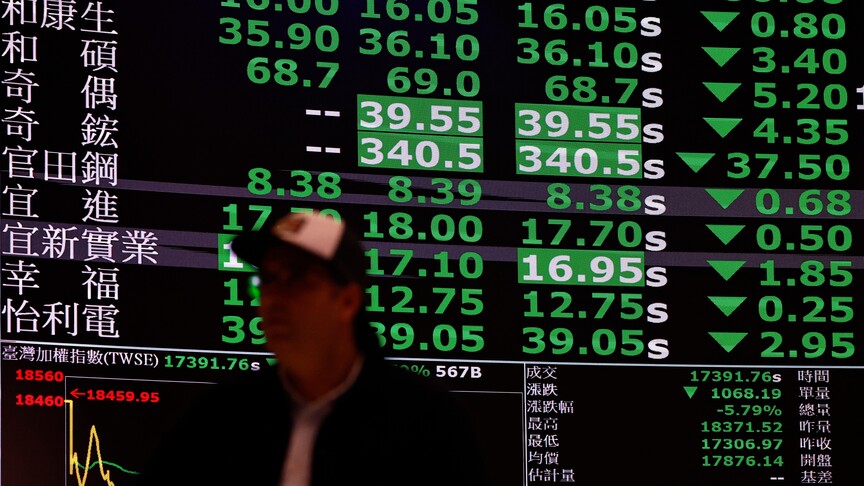
Meanwhile, Asian markets saw a selloff except for Japan, while the semiconductor sector recovered.
Analysts say that OpenAI is preparing to launch new models to showcase that AI developments are continuing, keeping investor interest alive.
China’s inflation came in at 1% year-on-year in June, while its Producer Price Index (PPI) rose 4.1%, within estimates, according to data released on Thursday.
Near the close, Japan's Nikkei 225 rose 1.4%, while South Korea's Kospi Index fell 0.73%, China's Shanghai Composite Index 0.15%, and Hong Kong's Hang Seng Index 0.81%.