
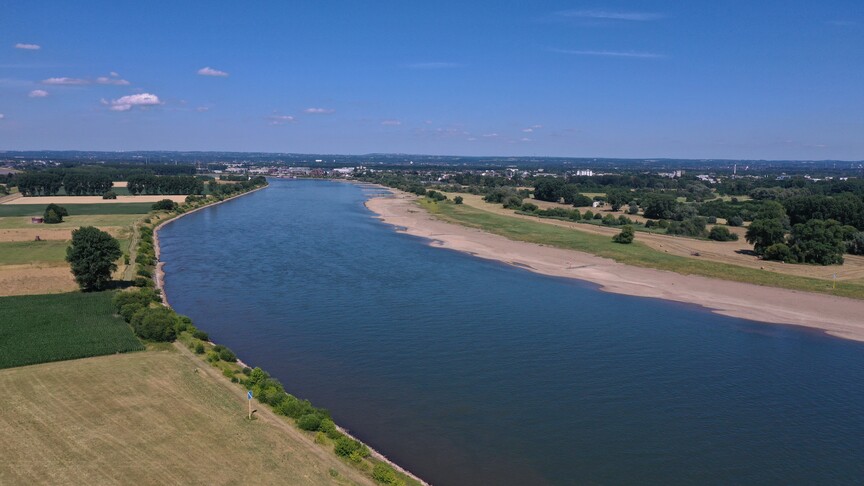
Persistent drought and historically low water levels – particularly on the Rhine, as well as on the Danube, Elbe and other waterways – are posing a massive threat to inland waterway shipping and putting pressure on key supply chains.
Because ships can now operate only with reduced cargo due to the shallow water, transportation costs are rising sharply, leading to bottlenecks in industrial supply chains.
In terms of economic consequences, less cargo can be transported as inland waterway vessels cannot fully utilize their capacity, resulting in a significant increase in the number of trips required to transport the same volume of goods.
Furthermore, shipping companies face rising costs: Higher transportation rates place a burden on energy-intensive sectors, the chemical industry and the steel and petroleum industries.
In addition, the country’s industries have to cut back on production as raw materials such as coal, steel, gravel or petroleum products arrive late at factories or not at all.
Low water levels in the rivers mean shifting to road transport: Freight must be rerouted to trucks and trains. Several federal states have eased the Sunday driving ban for trucks to alleviate the transportation crisis.
The crisis has also sparked an infrastructure debate as the federal government and the states are discussing immediate measures, the expansion of shipping channels and long-term investments in ports and waterways.
To avert impending supply shortages and maintain production in the economy and agriculture, the Federal Ministry of Transportation and the federal states have agreed on a comprehensive package of short-term crisis measures. The goal is to stabilize supply chains through close cooperation across road, rail and alternative waterways.
The economic damage from the river crisis is immense. According to surveys by the Kiel Institute for the World Economy, which shipping companies cite, similar periods of low water levels in the past have led to a noticeable decline in gross domestic product.
In addition, prices for consumer goods such as fuel are already rising in some regions, as the transport of petroleum products increasingly has to rely on more expensive truck fleets.
Since the waterways are blocked, the shipping industry must switch to road and rail transport in the short term. According to a statement released by Federal Minister of Transportation Steffen Bilger, the coming weeks will remain challenging and will require pragmatic action in close cooperation.
“The coming weeks will be challenging. Water levels on the Rhine and Danube will remain very low for the time being. That is why we must act pragmatically now. We have already implemented a number of concrete measures – ranging from exemptions to the truck ban to additional rail capacity and more flexible transshipment options. At the same time, we are working with the states to prevent further bottlenecks,” Bilger said.
However, in a recent statement, the Association of German Transport Companies criticized short-term, and superficial solutions.
Association Vice President Joachim Berends emphasized that the ongoing low water levels clearly demonstrate how vulnerable Germany’s logistics chains are. To ensure that transportation routes are built to be resilient in the long term, the association has clearly rejected calls for increased use of long trucks.
The association Chief Executive Oliver Wolff explained that such measures in no way solve the structural problems in freight transport. The roads are already overloaded, and more heavy trucks would massively exacerbate the problem of bridges and roads that are already in need of repair.
Instead, the focus must be placed entirely on intermodal transport, in which rail can efficiently handle large volumes of bulk goods.
For its part, the center-right government of Chancellor Friedrich Merz remains divided over how to fight low water levels.
Federal Minister of Transport Steffen Bilger is calling for the expansion of the river network.
“Fundamentally, we should all recognize that waterways deserve support because they are the most environmentally friendly mode of transportation,” he told the editorial network RND.
Bilger said that confidence in inland waterway transport can only exist if low-water problems do not occur on a regular basis.
Meanwhile, Federal Environment Minister Carsten Schneider spoke out against deepening rivers.
That cannot be the answer to the current situation, Schneider said. Rather, he added, what is needed is a “restoration” of the rivers, “moving away from canals toward natural rivers with meandering branches and floodplain landscapes that retain water across a wide area.”
Environmentalists, too, view river widening with skepticism and advocate instead for living rivers.
Meanwhile, a leading German economic expert warned of fuel price hikes as a result of the low river water levels.
“Disruptions in transportation can lead to physical bottlenecks. These usually don’t occur immediately. However, if low water levels persist, fuel is likely to become scarcer in some regions. Prices will then rise as well. In addition to the war in Iran, there would be another factor adding to the pressure,” Thilo Schaefer told the weekly news magazine Der Spiegel.
The head of the Digitalization and Climate Change division at the German Economic Institute in Cologne also pointed out that disruptions in waterway cargo traffic could severely impact the country’s economic growth.
“Following the 2018 drought, researchers at the Kiel Institute for the World Economy calculated the impact of the low water levels on the overall economy. They concluded that industrial production fell by 1% and total economic output by 0.4%. These exact figures should be viewed with some caution. However, the low water levels could stifle Germany’s already fragile economic growth,” Schaefer said.
“The frequency of low-water periods is increasing, and this is clearly due to climate change. We must remain committed to combating it. At the same time, we must adapt. For a transportation corridor as crucial as the Rhine, this means we must invest money so that it can continue to fulfill its function. Even if we cannot prevent drought, we can limit its effects,” he added.
news_share_descriptionsubscription_contact