Germany’s Merz dismisses speculation about early step-down
Friedrich Merz says he was elected for 4 years, determined to lead Germany out of ‘difficult phase’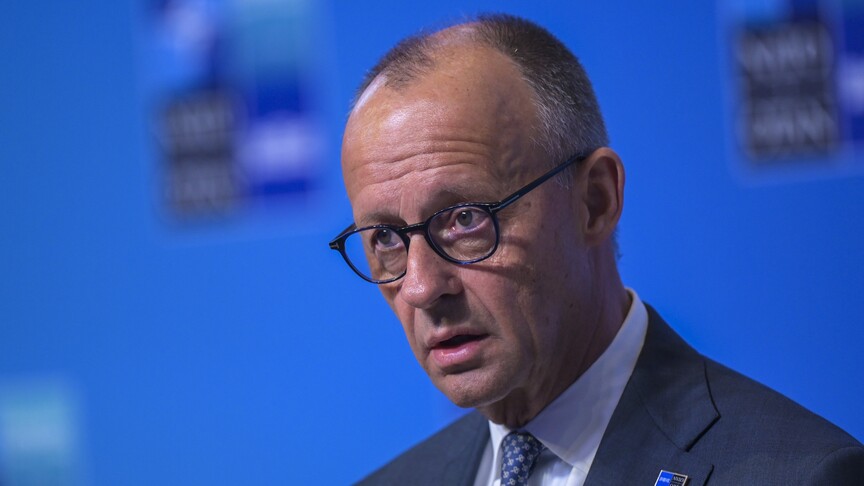
German Chancellor Friedrich Merz rejected speculation Tuesday that he could leave office early after his party’s heavy defeat in Saxony-Anhalt and weak poll numbers.
“I have been elected for four years, and I want us to use these four years to lead the country out of this difficult phase,” Merz told a business congress in Berlin.
He said he wanted the conservative CDU/CSU alliance’s coalition with the Social Democrats to succeed, and pledged to keep that work going.
“We want to be successful with this coalition, and I will do everything to continue to make that possible,” he said.
Merz defended the government’s record, saying the coalition had set more reforms in motion in just 16 months than the country had managed in many previous years.
Poll puts AfD well ahead of conservatives
The remarks came as debate about his future intensified after a sharp conservative loss in Saxony-Anhalt and a new nationwide poll put the right-wing Alternative for Germany (AfD) well ahead of his Christian Democrats.
A GMS survey published Monday put the AfD at a record 30% nationwide, 10 points ahead of Merz’s center-right Christian Democratic Union and its Bavarian sister party, the Christian Social Union, which fell to 20%, the lowest GMS polling for the conservatives.
The Social Democrats (SPD) stood at 11%. Combined, the chancellor’s coalition would fall short of a parliamentary majority if a national election were held this week.
The figures mark a sharp shift from the Feb. 23, 2025, federal election, when the CDU/CSU won 28.5% and the AfD 20.8%.
State votes seen as next test for Merz
The poll landed days before regional elections in Mecklenburg-Vorpommern and Berlin on Sunday. Those votes are being watched as a further test of Merz after the AfD won 43.8% in Saxony-Anhalt on Sept. 6. In that eastern state, the CDU slumped to a historic low of 17.2%.
Speculation has grown for weeks about a possible change of chancellor, with North Rhine-Westphalia Premier Hendrik Wuest named as a potential successor inside the CDU.
A leadership fight inside the Christian Democrats after the state elections would not, by itself, dissolve the Bundestag or force a snap national vote. If party pressure pushed Merz out, parliament could elect a new chancellor without a national vote.