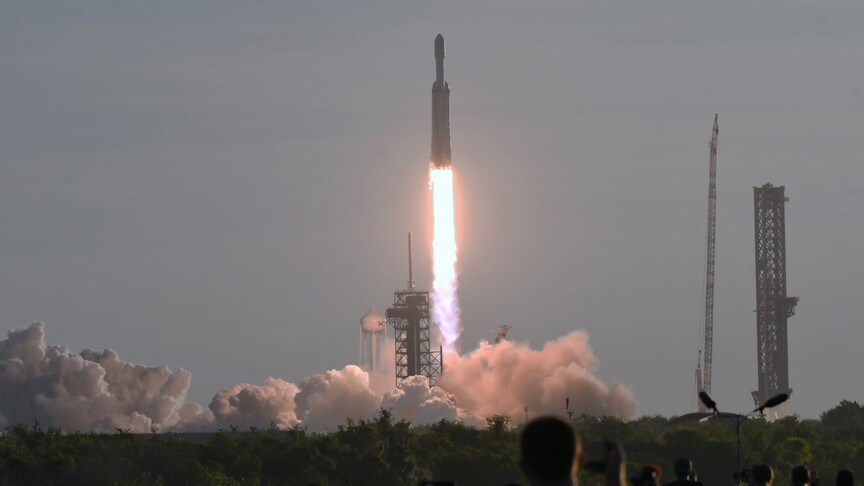
For decades, the space race was about getting there first.
The Soviet Union put the first satellite and first human into orbit. The US put the first humans on the moon. Mars then emerged as the distant destination that could define the next generation of exploration.
Today, the competition is becoming much more complicated.
In a wide-ranging conversation with Anadolu, Fabrizio Pinto, an Italian astrophysicist, former NASA Jet Propulsion Laboratory navigation specialist and founding director of the EKOSPACE Aerospace Research Center at Izmir University of Economics, explained how space is becoming an increasingly crowded economic frontier.
Where the Cold War space race was an ideological duel between two superpowers, today’s competition involves a growing number of countries and private companies pursuing commercial opportunities alongside scientific and strategic goals.
And as global space leaders prepare to convene at the 77th International Astronautical Congress in Türkiye’s Antalya, the conversation is shifting from how we explore space to how we govern, commercialize and protect it.
The moon, rather than Mars, has become the primary short-term objective of the international space race, according to Pinto.
"A few years ago, the answer would have been colonization of Mars," he told Anadolu. "In more recent years, due to competition with China, that goal has been reset to the moon, which is achievable in the shorter term."
The epicenter of this race is the lunar south pole, where permanently shadowed craters are believed to hold vast reservoirs of water ice. If extracted, that ice could provide drinking water and be processed into oxygen and rocket fuel, reducing the supplies that must be shipped from Earth.
NASA’s Artemis program aims to return astronauts to the moon and build the capabilities for a longer-term human presence, with the first crewed lunar landing now targeted for 2028.
China is pursuing a parallel program, targeting a crewed lunar landing before 2030 and developing the Chang’e-7 and Chang’e-8 missions as steps toward its planned International Lunar Research Station, which is expected to take shape in the 2030s.
In 2023, India made history by becoming the first country to land a spacecraft near the lunar south pole with Chandrayaan-3.
Yet, the push to control cislunar space – the region between Earth and the lunar orbit – is as much about terrestrial security as it is about science.
"The states are competing because, politically speaking ... the conquest of cislunar space is basically the strategic height to be conquered in order to dominate the Earth," he said.
"There is a fear on the part of some that the moon will become territory from which the Earth can be controlled, attacked or influenced."
Asked about establishing a sustained human and commercial presence beyond Earth rather than simply visiting the moon or Mars, Pinto called it “the central task.”
"To sustain life on a different planet – even on the International Space Station – is a huge enterprise, because the human body cannot operate above seven or eight miles of altitude from the surface of the Earth."
Keeping a functioning outpost running, he said, means treating it like an industrial supply chain.
Pinto said the current race is being fought simultaneously by governments and private companies, and the two are increasingly impossible to separate.
"When we say the United States, we cannot mean NASA anymore," he said. "Right now, what we mean is SpaceX, maybe Blue Origin, Virgin Galactic."
Modern space architecture relies heavily on commercial subcontracting. NASA, for instance, has contracted SpaceX and Blue Origin to build human landing systems that will carry astronauts from lunar orbit to the moon's surface.
According to analytics firm BryceTech, commercial providers accounted for 87% of the world's orbital launches in 2025.
At the same time, rapid technological growth has outpaced international law.
The foundation of space governance – the United Nations' 1967 Outer Space Treaty – banned the placement of nuclear weapons and other weapons of mass destruction in orbit and declared that no nation could claim sovereignty over celestial bodies.
But the treaty was written for an era when only a few nations had demonstrated independent launcher capabilities.
"The existing laws cannot be enforced," Pinto argued, pointing to modern military discussions surrounding orbital maneuvering, counter-space capabilities and even nuclear-powered space hardware.
"If China lands on the moon and claims an immediate area for exploration, can China actively do anything in order to avoid the Americans landing in the same area or vice versa? Nobody has ever been in that situation."
The issue moved from hypothetical to headline news this week.
On Monday, US Secretary of the Air Force Troy Meink publicly confirmed for the first time that the US has deployed on-orbit "space control weapons" to protect American satellite architecture from adversary interference.
China subsequently called on Washington to "stop preparing for war in outer space" and avoid triggering a new arms race.
The growing energy and environmental footprint of AI data centers on Earth has sparked proposals to move massive server farms directly into space.
"Clearly here, there is another mechanism to generate revenue," Pinto said.
A US startup called Starcloud has already run an AI model on an Nvidia chip aboard a satellite, Google is building solar-powered satellites for AI processing and SpaceX has proposed a constellation of up to 1 million satellites for orbital computing.
China is developing its own space-based AI computing network, having already launched a cluster of satellites designed to process data in orbit.
Yet, Pinto cautioned, orbital data centers carry hidden environmental costs on Earth.
“If those things are in space, you could argue that the impact is lessened. However, you must not forget that the spacecraft eventually needs to reenter the atmosphere. And when they reenter, we're talking about millions of these vehicles, we are going to have some kind of chemical pollution and thermal effects,” he said.
At the same time, low-Earth orbit is undergoing a quiet traffic crisis. Where space once held a few thousand active payloads, commercial satellite constellations are scaling into the tens of thousands.
As orbits become more crowded, relying on ground teams to guide individual spacecraft becomes harder to manage, he said.
Historically, satellites relied on Earth-based radio dishes, like NASA's Deep Space Network, to determine their position and guide adjustments to their course.
Pinto, who worked on NASA's landmark Deep Space 1 mission, the first probe to test autonomous spacecraft navigation in deep space, explained that traditional manual guidance cannot scale to meet modern orbital density.
Autonomous navigation – allowing spacecraft to make navigation decisions onboard – is becoming essential rather than experimental, he said.
Many of these issues will be on the agenda when the international space community gathers in the Turkish resort city of Antalya next month.
The 77th International Astronautical Congress will take place from Oct. 5 to 9, marking the first time Türkiye has hosted the annual event.
Organized by the International Astronautical Federation and hosted by the Turkish Space Agency, the congress is expected to bring together 10,000 attendees, including leaders from NASA, the European Space Agency, China’s and India’s space programs and other agencies, under the theme “The World Needs More Space.”
Pinto has watched Türkiye’s space ambitions develop since arriving in the country in 2017, a year before the Turkish Space Agency was established.
He pointed to Türkiye's first astronaut mission to the International Space Station, its communications satellites and its lunar ambitions as milestones in the country's development as a spacefaring nation.
Drawing a parallel to Türkiye’s rapid rise over the last decade into a global exporter of uncrewed aerial vehicles, Pinto sees space as the natural next frontier for developing industrial ecosystems.
"I expect that Türkiye will be able to do the same in space, but it takes time and investment,” he said. “A deal in aerospace has a multiplier effect – it isn't just one spacecraft, everybody benefits."
news_share_descriptionsubscription_contact

contact_the_ombudsman
is_there_an_error_in_this_story