Anadolu Ajansı © 2026


Since the 1979 Iranian revolution, the country's nuclear program has been the key point of contention between Tehran and Washington, and one of the most consequential geopolitical disputes of the modern era.
In the past year alone, it has escalated into two full-scale wars.
The program has, over the years, drawn waves of crippling economic sanctions from Western countries, profoundly reshaping Iran's economic trajectory.
It has also sparked repeated diplomatic standoffs and led to numerous scathing reports and resolutions against the Islamic Republic at the UN nuclear agency, as recently as last week.
What is often overlooked is that Iran’s nuclear program began under the pro-Western Shah Mohammad Reza Pahlavi and was initially nurtured with US support as part of Washington’s Atoms for Peace initiative.
In the early 1950s, with Mohammad Reza Pahlavi on the throne, Iran launched an ambitious nuclear program, envisioned for energy purposes and as a hedge against the possible depletion of its vast oil and gas reserves.
The Shah enjoyed the full backing of the US, the UK, France, and Germany.
In March 1956, Tehran and Washington signed an agreement that would become the bedrock of their nuclear cooperation and mark the first introduction of nuclear technology to Iran.
Ratified in February 1958, the pact preceded Iran's membership in the IAEA by a year – and also predated the establishment of the University of Tehran's Nuclear Center.
Nuclear collaboration deepened considerably under President Eisenhower's "Atoms for Peace" initiative, which laid the groundwork for Iran's large-scale nuclear activities.
In 1967, in a significant move, the US provided Iran with a 5-megawatt Tehran Research Reactor, along with highly enriched uranium fuel. Around the same time, Washington also provided hot-cell facilities for handling and processing radioactive materials, a crucial step for research and medical isotope production.
When the Nuclear Non-Proliferation Treaty (NPT) opened for signatures in 1968, Iran was among the first countries to join it. After that, the country's nuclear program gradually came under the oversight of the UN nuclear watchdog.
By the mid-1970s, Iran had signed a nuclear cooperation pact with India, renewed its nuclear fuel cycle agreement with the US, and invited American companies to supply equipment and services for reactor operations. During the same decade, Tehran also maintained nuclear fuel cycle arrangements with France, Germany and the UK.
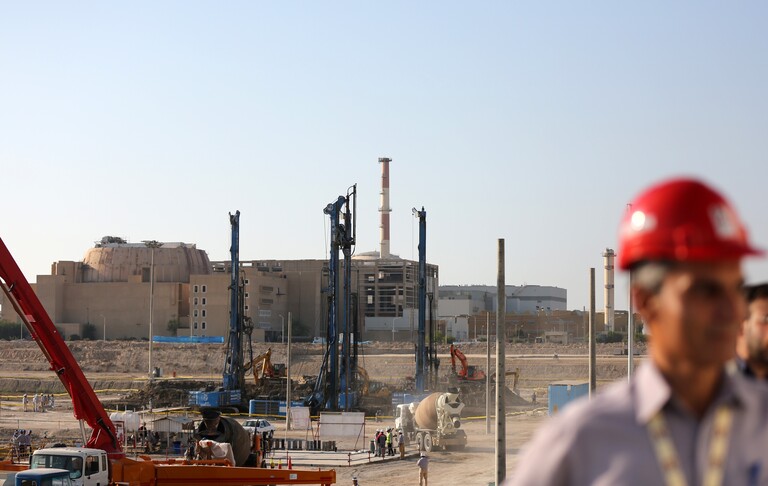
Take, for instance, the Bushehr Nuclear Power Plant, Iran's first nuclear facility of its kind. It was built with assistance from West Germany's Siemens/KWU. But soon after the revolution, German contractors left the country and abandoned the project mid-way.
It was a golden decade as far as Iran’s nuclear ambitions were concerned. All of that changed with the 1979 revolution, which toppled the Shah's administration and brought an abrupt end to the era of Western-Iranian nuclear cooperation.
The 1979 revolution, led by Ayatollah Khomeini, was swiftly followed by a diplomatic rupture between Iran and the US, triggered by the US embassy takeover in Tehran. It was followed by the Iran-Iraq War in 1980, which continued for eight years.
In the absence of foreign partnerships, Iran's nuclear program ground to a near-complete halt.
During the early 1980s, brief attempts were made to resume work on the Bushehr plant, situated on the Persian Gulf coast, but repeated Iraqi airstrikes hampered progress. Still, Iran did manage to acquire a small experimental reactor from China for enrichment research.
In 1985, a uranium exploration project was launched in the central province of Yazd, while the country's leadership decided to pursue centrifuge-based enrichment, enlisting assistance from China, Russia, Canada, Austria, Spain, and others.
A year later, Tehran signed an agreement with Pakistan that allowed young Iranian nuclear scientists to train there.
In 1988, just as the Iran-Iraq War drew to a close, Iran and Argentina signed a deal for uranium enrichment technology transfer, which was scrapped in 1991 under US pressure.
By the early 1990s, Iran began giving its flagging nuclear program a concerted push, engaging more seriously with friendly countries.
In 1994, Tehran signed an $870 million deal with Russia to complete the Bushehr nuclear power plant, alongside a separate $110 million contract with China to build uranium conversion facilities in Isfahan.
In the late 1990s, as Iran pressed ahead with its nuclear revival efforts, US pressure on Tehran intensified considerably. In response, the Iranian government issued a formal statement insisting it was not pursuing nuclear weapons.
A few years later, in the early 2000s, under the reformist government of President Mohammad Khatami, satellite imagery revealed nuclear facilities in the central Iranian cities of Natanz and Arak, sparking fresh concerns over possible weapons development.
The revelations came less than a year after the September 11 attacks, at a time when President George Bush had described Iran as part of the "axis of evil."
The Khatami administration invited then-IAEA chief Mohamed ElBaradei to the country for talks, a move that coincided with Iran's first nuclear enrichment activities in 2002.
A year later, intensive nuclear negotiations began with direct European Union involvement, ending in the so-called “Saadatabad Declaration.” Under its terms, Iran agreed to suspend its enrichment program, sign the Additional Protocol, and allow enhanced inspections.
The 2005 election of Mahmoud Ahmadinejad as Iran's president proved a turning point. During his tenure, Iran resumed enrichment activities at Isfahan and Natanz, prompting IAEA warnings and, eventually, referral of the file to the UN Security Council in 2006. Sanctions followed under Resolution 1737, later reinforced by Resolutions 1747 and 2010.
In 2010, a brief diplomatic reprieve emerged when Iran, Turkey, and Brazil signed the Tehran Declaration, an accord that recognized Iran's right to peaceful nuclear energy under the NPT, including enrichment for civilian purposes, without discrimination.
After Hassan Rouhani assumed presidency in 2013, Iran extended an olive branch to the West, signaling willingness to engage on its nuclear program. That overture paved the ground for years of negotiations in multiple global cities, culminating in the Joint Comprehensive Plan of Action (JCPOA) in July 2015.
The landmark deal imposed significant restrictions on Iran's nuclear activities in exchange for sanctions relief.
In Iran, the agreement drew a mixed response with supporters hailing it as a historic breakthrough and critics questioning its long-term viability.
Under the accord, Iran agreed to cap uranium enrichment at 3.67% purity, limit its enriched uranium stockpile to 300 kilograms for 15 years, and confine enrichment to the Natanz facility in Isfahan. It also committed to reducing its installed centrifuges to roughly 5,060 of its oldest models and redesigning the Arak heavy-water reactor.
In return, all nuclear-related UN, US, and EU sanctions were eased, including the unfreezing of billions of dollars in assets, the termination of oil, banking, and shipping restrictions, and the eventual lifting of conventional arms and ballistic missile embargoes.
It proved short-lived as Trump, in May 2018, withdrew the US from the agreement and reimposed unprecedented sanctions. Iran responded by gradually scaling back its compliance, ramping up enrichment to 60% purity and expanding other nuclear activities.
President Joe Biden had vowed to revive the deal reached by his Democratic predecessor Barrack Obama, but that promise went unfulfilled. Despite multiple rounds of negotiations during Biden's tenure, a breakthrough still evaded.
After Trump returned to office, Iran and the US engaged in at least two rounds of diplomatic talks, both mediated by Oman, and both were interrupted by wars on Iranian soil.
In June last year, just as both sides claimed progress, Israel launched an attack on Iran, killing top military commanders and a number of high-profile nuclear scientists. In the final days, the US intervened, targeting three nuclear sites at Natanz, Isfahan, and Fordow.
In late February this year, the US and Israel jointly carried out another attack, triggering an all-out war. Yet diplomacy persisted after the truce, eventually resulting in a memorandum of understanding (MoU) signed electronically by the two presidents early on Thursday.
As part of the MoU, the nuclear issue is set to be discussed after the war ends on all fronts and other conditions are fulfilled. What the final arrangement will entail remains unclear – whether Iran will retain the right to maintain high enrichment levels and keep its nearly 400-kilogram stockpile of enriched uranium.
One provision, which Trump and Netanyahu often bring up, features prominently in the MoU, and that is Iran's explicit declaration that it will not build a nuclear weapon.
news_share_descriptionsubscription_contact