- A child’s kite ‘must’ be shot out of the sky, not because it endangers Israel, but because it endangers the story Israel needs to tell itself and the world to continue its genocide
- Dr. Mohsen al Attar is a Reader in International Law at Xi’an Jiaotong-Liverpool University
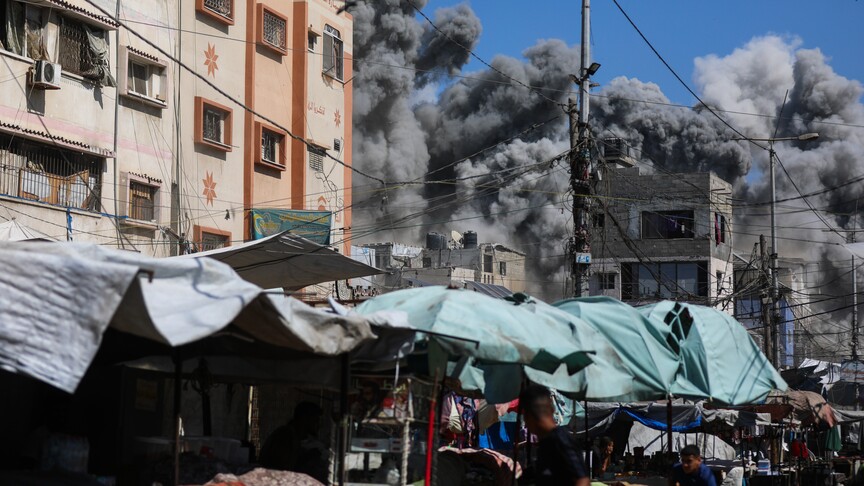
It is difficult to fathom what it is like to be Palestinian these days. The so-called Board of Peace celebrates the progress it has achieved, just as members of the Israeli parliament (Knesset) reaffirm their ambition to ethnically cleanse Palestinians from Gaza, just as Israelis demolish record numbers of homes in the West Bank, just as the UN laments the venomous infestations further immiserating the lives of displaced civilians, and just as Germany justifies its unconditional support for Israel before the International Court of Justice (ICJ), despite tens of thousands of dead children and counting.
In December 2023, as Israel’s genocidal violence was picking up steam, UN human rights chief Volker Turk warned that “the dehumanization of Palestinians” was “very disturbing and must cease immediately.”[1] In fact, Israel’s policy of dehumanizing Palestinians has a history as old as its occupation.
Israeli dehumanization policy
As early as 1969, then-Israeli Prime Minister Golda Meir declared that “there was no such thing as Palestinians.” This was only the beginning. Another former prime minister, Menachem Begin, called them “beasts walking on two legs,” an image echoed by the current Prime Minister Benjamin Netanyahu, who has branded them as wild beasts. According to the then Minister of Defense, Moshe Dayan, they were dogs, fit only to “continue to live like dogs.” And former Prime Minister Ehud Barak, a supposed progressive, cast the region as a jungle and Israel as the lone “villa” within it — beyond the wall, monsters live.
This is not simply a political phenomenon. Shmuel Agnon, a winner of the Nobel Prize for Literature, described Palestinians as dogs and, like a "good novelist," added colorful adjectives such as cheating, filthy and undignified. In a song that soared in the Israeli charts, the Israeli rapper Subliminal condemned Palestinians as “swarms of rats” who “will die in their rat holes.” Study after study of Israeli children’s books and drawings finds Palestinians portrayed as pigs, monsters, vipers and sundry threatening animals.
In a glimmer of hope, alongside the multiplication of Israeli dehumanization practices, we find a boost in the critiques of them. In 2024, a year into Israel’s genocide, the world’s leading medical journal the Lancet published a piece precisely on this theme, challenging the health professionals supportive of Israeli violence: “The justification of indiscriminate Israeli attacks by some health care professionals is possible only because of the dehumanization of Palestinian people, predicated on racial prejudices.” Most telling was the journal’s recognition of the deliberate character of that dehumanization: “Propagating a belief that some lives have lower value and less right to self-determination, usually based on racist or discriminatory notions of worthiness, is a fundamental step toward building acceptance for massacres.”[2]
It would be a mistake to reduce dehumanization to rhetoric or propaganda. Both are outward-facing activities, easily dispelled. Dehumanization runs deeper: it is a socio-educational campaign designed to permanently shape how a people is perceived, consigning them to a lesser category of being, below the threshold at which they are entitled to any rights whatsoever. Dehumanization is aimed at achieving a durable form of domination, one that first governs how the group in question is to be treated, as in the massacres described by the Lancet, and secondly dictates the very definition of who they are.
A fragile fiction
This dehumanization is equally directed at Israelis, relieving the population of any guilt or qualm about the violence done in its name. Children taught that Palestinians are threatening animals bent on harming them grow up without compassion for their neighbors. It is no surprise, then, that a majority of Israeli society has actively supported the genocide, or that a majority now calls for ethnic cleansing, not simply in Gaza, but in the West Bank and Jerusalem as well.
The relationship runs both ways: dehumanization authorizes the violence, just as the violence is marshalled to sustain the dehumanization. Demolishing schools and hospitals, blowing up fishing boats and shooting down kites are acts of destruction, but also of maintenance, seeking to preserve the fiction of Palestinian "inhumanity."
For the fiction is fragile -- if Palestinian children are seen reading books or flying kites, the manufactured image of the "animal" collapses. If a child is pictured with bandages on her arms and tears in her eyes, the human surges forward, compelling Israelis not to ask about Palestinian "inhumanity" but to confront the inhumanity of what Israel does.
Israel has spent half a century telling us stories: none of them about Palestinians, all of them about why Israel "needs" to continue killing them. This is why a child’s kite "must" be shot out of the sky, not because it endangers Israel, but because it endangers the story Israel needs to tell itself and the world to continue its genocide. Three years into a genocide, perhaps it is time we started listening to Palestinian stories instead.
[1] https://news.un.org/en/story/2023/12/1145132
[2] https://www.thelancet.com/journals/lancet/article/PIIS0140-6736(24)00043-6/fulltext
*Opinions expressed in this article are the author's own and do not necessarily reflect the editorial policy of Anadolu.