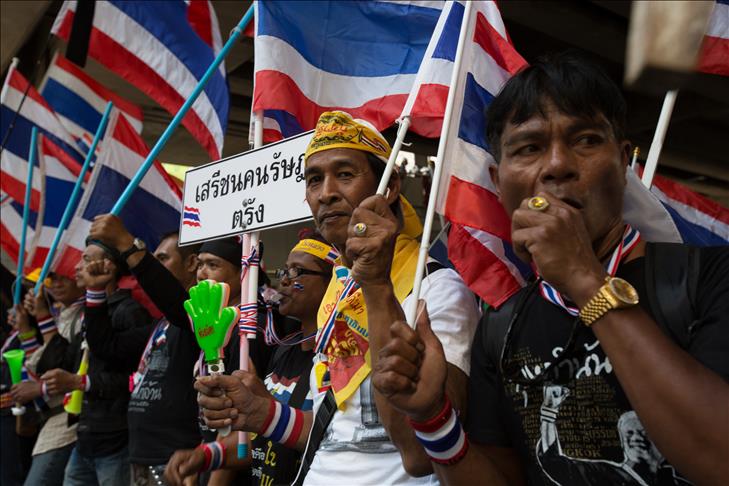
For the first time in a month, hundreds of pro-government demonstrators gathered Thursday in the Thai capital, Bangkok, to support the embattled prime minister, Yingluck Shinawatra, as she faces charges of negligence of duty filed by the country's Anti-Corruption Commission.
The Red Shirts, as they are known, set up a stage in front of the commission and lambasted it for what they called its "double-standard" and "lack of justice." The Red Shirts are mostly farmers and workers from the eastern part of the country.
Also Thursday, the prime minister's legal team arrived to formally hear the charges against her. The prime minister had been summoned to hear the charges but did not appear. She is accused of having ignored massive financial losses in a subsidy program through which the Thai government is buying rice from farmers at 50 percent above the market price.
"In Thailand, there is no justice," said Nusa, a demonstrator who did not want to give her family name. "The anti-corruption agency has been set up by bandits and it is not neutral. The Democrat Party has cheated much more through the rice scheme than the current government, but its case has not been considered yet."
A corruption case against the former government, led by the Democrat Party from January 2009 to July 2011, in relation to a similar rice subsidy program has been pending for years at the Anti-Corruption Commission, without progress. In contrast, charges against Shinawatra have been filed in less than a month.
The commissioners have said they encountered problems in gathering evidence in the Democrat party’s corruption case. But for government supporters, the difference between the two cases reflects the commission's bias.
"We want the Anti-Corruption Commission to deal with all the cases in an equal manner," said Wathana Rodwano, a Red Shirt protester from Ratchaburi province, east of Bangkok. "If they are not impartial, we will just close its offices."
The commission must now investigate further and decide whether to refer the case for trial before the Senate.
The rice-pledging scheme was initiated soon after Shinawatra's Puea Thai Party (For the Thais) won elections in July 2011 with 75 % of the vote. At first, the program was popular with farmers, but it quickly ran up hundreds of billions of bahts (billions of euros) in financial losses. It was also criticized for opening the door to corruption.
Thousands of farmers who have not been paid for the rice they sold under the scheme to the government have been protesting in Bangkok since the beginning of February. They are supported by anti-government demonstrators who have been asking for Shinawatra's resignation since the beginning of November.
englishnews@aa.com.tr