- Compared with NASA’s iconic Hubble telescope, launched in 1990, it can survey the sky about 1,000 times faster
- Its primary mission to last 5 years, with a goal of operating for 10 years
NASA has launched a new flagship space telescope designed to survey the cosmos on a scale never before attempted, seeking to shed light on two of the universe's deepest mysteries: dark matter and dark energy.
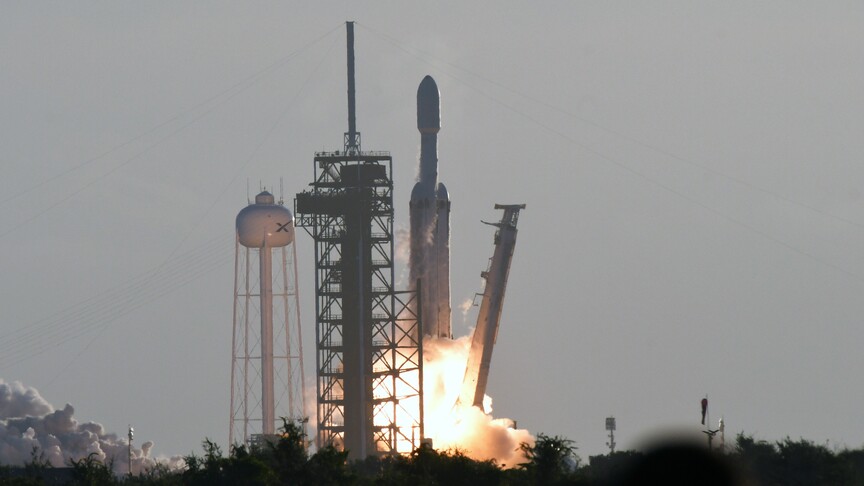
The Nancy Grace Roman Space Telescope lifted off Sunday aboard a SpaceX Falcon Heavy rocket from Kennedy Space Center in Florida. It now joins the Hubble and James Webb space telescopes as NASA's third active flagship observatory, but is built for a fundamentally different kind of job, emphasizing speed and scale over close-up detail.
NASA Administrator Jared Isaacman described Roman as a mission that will provide "a new atlas of the universe."
Here is what to know about the mission.
What the telescope is
Named after Nancy Grace Roman, NASA's first chief astronomer and an early champion of space-based observatories, the telescope carries a 2.4-meter (7.9-foot) primary mirror — the same size as Hubble's.
But its wide-field camera can capture an area of sky that mission scientists say is roughly 100 times larger than Hubble's infrared instrument in a single shot, while matching Hubble's image sharpness.
That combination of a wide view and high resolution is unusual. Most telescopes trade one for the other. NASA officials say Roman will be able to survey the sky about 1,000 times faster than Hubble, turning observations that once required hundreds of pointings into just a handful.
The observatory's main camera, the Wide Field Instrument, holds a 300-megapixel infrared detector array. A second instrument, the Coronagraph, is a technology demonstration built to block the glare of distant stars so that planets orbiting them can be seen directly — a capability future missions are expected to build on.
Unlike Hubble, which circles roughly 300 miles above Earth, Roman is headed to a gravitationally stable point in space known as the second Sun-Earth Lagrange point, or L2, located about 1.5 million kilometers (930,000 miles) from Earth. That is the same neighborhood occupied by the Webb telescope.
The journey will take more than 3 months, after which Roman will spend additional weeks on calibration before science operations begin, with first images expected around January.
What will it do?
Roman's science mission centers on three broad goals.
The first is dark energy, the unexplained force thought to be accelerating the expansion of the universe. Scientists will use Roman to map the large-scale structure of hundreds of millions of galaxies across cosmic time, testing whether dark energy is constant, as Albert Einstein's equations imply, or changes over time.
The second is dark matter, the invisible substance believed to make up most of the universe's mass but which has never been directly detected. Roman's wide surveys are expected to trace how dark matter's gravity has shaped the distribution of galaxies since the Big Bang.
The third is exoplanets, or planets outside our solar system. Roman will use a technique called gravitational microlensing, watching for the way a passing star's gravity briefly bends and brightens the light of a background star, to detect distant, often small or cold planets that other methods struggle to find.
Scientists have said the survey could reveal tens of thousands of new exoplanets, and mission materials point to a target of roughly 2,600 planets detected through microlensing alone in a single planned survey of the inner Milky Way.
Beyond its three headline goals, officials say Roman's data archive will be made publicly available and is expected to support research well beyond the mission's original scope, given the sheer volume of galaxies, stars and other objects it will record.
The observatory is expected to downlink about 1.4 terabytes of data each day. Machine learning, artificial intelligence (AI) and citizen scientists will help process the volume, according to NASA.
First public images are targeted for early 2027.
It has a five-year primary mission, with NASA aiming for the telescope to operate for up to 10 years.
Why it matters
Dark energy and dark matter together are thought to account for the vast majority of the universe's total mass and energy, yet neither has been directly observed. Understanding them is considered one of the central unsolved problems in modern physics and cosmology.
“Roman will be a discovery machine that will bring us closer than ever before to answering humanity’s most profound questions about our cosmic history,” said Nicky Fox, NASA's associate administrator for science.
Roman is designed to address that problem not by looking closer, as Webb does, but by looking wider and faster, building statistical samples of galaxies and cosmic structures large enough to detect subtle patterns invisible in smaller studies.
NASA has described the three flagship telescopes — Hubble, Webb and Roman — as complementary rather than competing, each suited to different kinds of observations.
The mission also carries symbolic weight tied to its cost and schedule. NASA said Roman launched about eight to nine months ahead of its most recent target and within its roughly 4.3 billion dollar budget, an unusual outcome for a large space science mission and one NASA leadership has held up as a model for future projects.