Henri B. Kagan and Kenso Soai spent decades investigating why chemistry, and life itself, often favors one molecular “hand” over its mirror image.
Their separate discoveries eventually revealed how a tiny initial imbalance could be amplified until a chemical reaction overwhelmingly produced one molecular form.
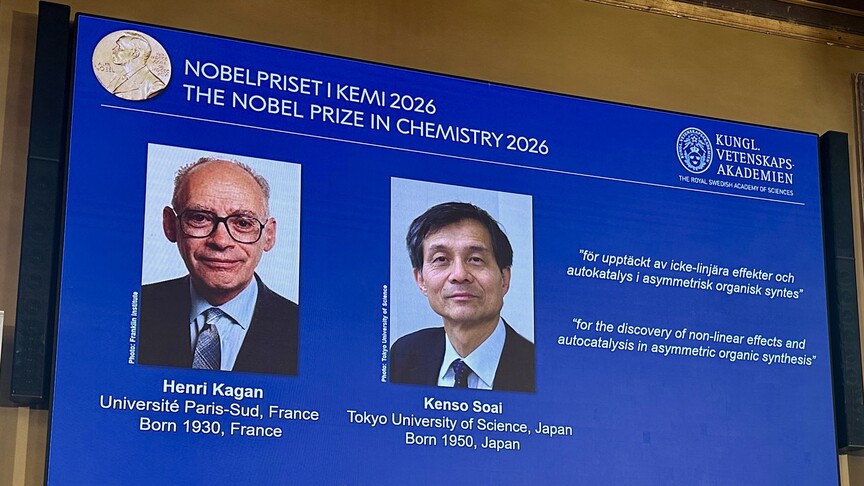
The Royal Swedish Academy of Sciences awarded the French and Japanese researchers the 2026 Nobel Prize in Chemistry on Wednesday “for the discovery of non-linear effects and autocatalysis in asymmetric organic synthesis.”
The two scientists will share the 12 million Swedish kronor (around $1.2 million) prize equally.
Their work addresses a fundamental feature of chemistry known as chirality. Some molecules exist in two forms that contain the same atoms but are mirror images of one another, much like a person’s left and right hands.
These forms, known as enantiomers, can behave very differently when they interact with living organisms. One may have the intended therapeutic effect in a medicine, while its mirror image may be ineffective or cause unwanted effects.
Living organisms are overwhelmingly “homochiral,” meaning biological molecules tend to use only one of the two possible forms. Proteins, for example, are constructed almost exclusively from one form of amino acid, while DNA relies on sugars with the opposite orientation.
For more than a century, chemists struggled to explain how such uniformity could arise, and how it might be recreated without relying on living systems.
“Henri Kagan and Kenso Soai have provided a solution to a chemical mystery that is over a century old: how homochirality can emerge spontaneously,” Nobel Committee for Chemistry Chair Heiner Linke said.
Henri Kagan: Pioneer of asymmetric catalysis
Born in Boulogne-Billancourt, France, in 1930, Kagan studied at the Sorbonne before earning his doctorate from the College de France in 1960.
He spent nearly four decades at Universite Paris-Sud, now part of Paris-Saclay University, and became one of the leading figures in asymmetric catalysis, the use of catalysts to favor one molecular mirror image over another.
Among his influential early contributions was the development of DIOP, a specially shaped molecule known as a chiral ligand. When combined with a rhodium catalyst, it enabled chemical reactions to produce a high proportion of a desired enantiomer.
The approach influenced generations of chemists and encouraged the development of numerous related catalysts used in asymmetric hydrogenation and other reactions important to pharmaceutical manufacturing.
Kagan’s Nobel-recognized breakthrough came in 1986, when he demonstrated what became known as a nonlinear effect.
Scientists had generally expected the “handedness” of a reaction’s product to correspond directly to that of its catalyst. Kagan showed that the relationship could instead be nonlinear: even a modest imbalance in the catalyst could produce a substantially greater excess of one mirror-image product.
The finding provided chemists with both a practical method of amplifying molecular asymmetry and a new way to examine how catalysts interact during reactions.
Now 95 and a professor emeritus, Kagan had already received many of chemistry’s leading honors, including the 2001 Wolf Prize in Chemistry and the Franklin Institute’s 2005 Bower Award. He was also elected to the French Academy of Sciences and appointed a Knight of the Legion of Honor.
Kenso Soai: A reaction that copies itself
Soai was born in Hiroshima, Japan, in 1950 and earned his doctorate in organic synthesis from the University of Tokyo in 1979 under prominent chemist Teruaki Mukaiyama.
He later worked with stereochemistry specialist Ernest Eliel at the University of North Carolina at Chapel Hill before joining the Tokyo University of Science in 1981. He became an associate professor in 1986 and a full professor in 1991.
Building on the broader idea of asymmetric amplification, Soai pursued an even more ambitious objective: creating a reaction in which a chiral product catalyzes the production of more of itself.
This process is known as asymmetric autocatalysis. Once a small amount of one molecular form appears, it accelerates the creation of additional molecules with the same handedness, strengthening the initial imbalance with each cycle.
In 1995, Soai published the first reaction with the potential to become homochiral. By 2003, he had demonstrated a reaction beginning with non-chiral materials that produced only one of two possible mirror-image molecules.
“Other than life itself, no one had previously achieved this feat,” the Royal Swedish Academy said.
The process became known as the Soai reaction and remains one of organic chemistry’s best-known demonstrations of how an almost imperceptible imbalance can grow into near-total molecular uniformity.
From drug development to life’s origins
Kagan’s nonlinear effects showed that molecular asymmetry could be amplified. Soai then demonstrated a self-reinforcing chemical system capable of producing and reproducing one molecular orientation.
Together, their findings reshaped scientists’ understanding of how chirality is created, strengthened, and transmitted.
The discoveries have helped chemists design more selective reactions for manufacturing medicines, fragrances, and advanced materials. They have also provided a laboratory model for investigating how life on Earth may have come to rely on only one mirror-image form of many essential molecules.
More than 40 years after Kagan’s decisive experiment and three decades after Soai’s landmark reaction, the Nobel Prize recognizes two researchers whose work taught chemistry how to choose a side.