Mucahithan Avcioglu
17 July 2026•Update: 17 July 2026
- Istanbul Declaration expected to set out common environmental, climate vision ahead of COP31 in Antalya
The Developing Eight Organization for Economic Cooperation (D-8) can become a transformative force in the global climate agenda, Türkiye’s environment minister and COP31 president said on Friday.
“The D-8 family, with its geography stretching from Asia to Africa and the Middle East and a population exceeding 1 billion, has a special place and transformative power in the global climate agenda,” Murat Kurum said at the COP31 D-8 International Ministerial Meeting in Istanbul.
“The common will to be demonstrated by the D-8 is of particular importance for COP31’s implementation-oriented approach,” he added.
Representatives responsible for environment and climate affairs from Bangladesh, Egypt, Indonesia, Iran, Malaysia, Nigeria, Pakistan, Azerbaijan and Türkiye attended the meeting.
Kurum said the gathering was particularly significant as Türkiye prepares for its COP31 presidency and that cooperation among D-8 members would strengthen the role of developing countries in the global climate agenda.
Climate change is no longer a future risk but a global challenge directly affecting economic development, cities, food security, energy systems and public welfare, he said.
Despite numerous commitments, a significant gap remained between climate pledges and implementation on the ground, he added.
‘Dialogue, consensus, action’
Kurum said Türkiye was ready to share its experience in post-disaster reconstruction, Zero Waste practices, resilient cities, energy efficiency, the circular economy and sustainable infrastructure.
“We see COP31 as an implementation platform where climate adaptation is accelerated, access to finance and technology is strengthened, urban resilience is enhanced and nature-based solutions are expanded,” he said.
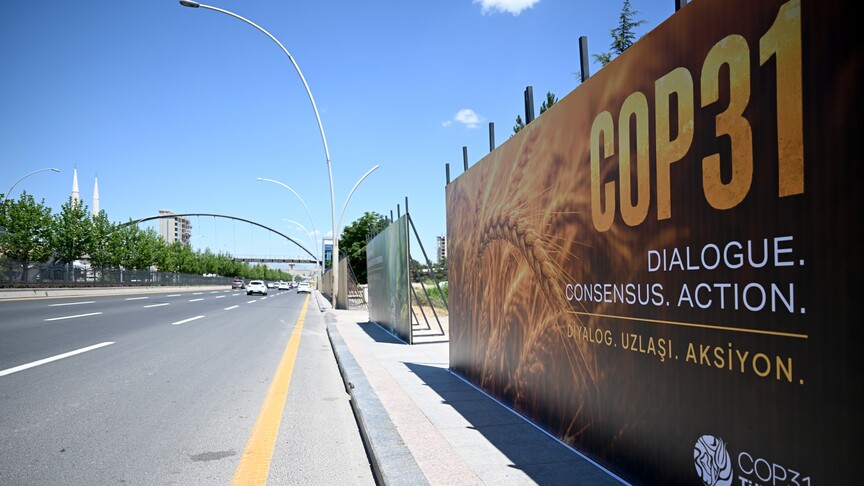
He said the COP31 presidency had adopted three main principles: “dialogue, consensus and action.”
Türkiye’s COP31 Action Agenda includes 10 priority areas, including reducing methane emissions, accelerating electrification and energy efficiency, promoting sustainable agriculture, supporting green industrialization and building climate-resilient cities.
It also prioritizes youth participation, resilient systems and stronger cross-sector cooperation.
Global targets for 2035
Kurum said Türkiye had proposed measurable global implementation targets extending to 2035.
These include raising the global electrification rate to 35%, halving the growth rate of global waste generation, reducing energy-use intensity in buildings by at least 25% and increasing circular material use in production and manufacturing to at least 15%.
The targets also seek to expand climate education and improve the speed, effectiveness and inclusiveness of climate finance.
Kurum said one of the main COP31 initiatives would be the Climate Implementation Bridge, designed to help developing countries turn climate commitments into investable projects and gain access to financing.
The meeting was expected to address climate adaptation, loss and damage, climate finance, a just transition and stronger cooperation among D-8 countries.
Kurum said the Istanbul Declaration would set out the group’s common environmental and climate vision and make an important contribution to COP31 in Antalya.