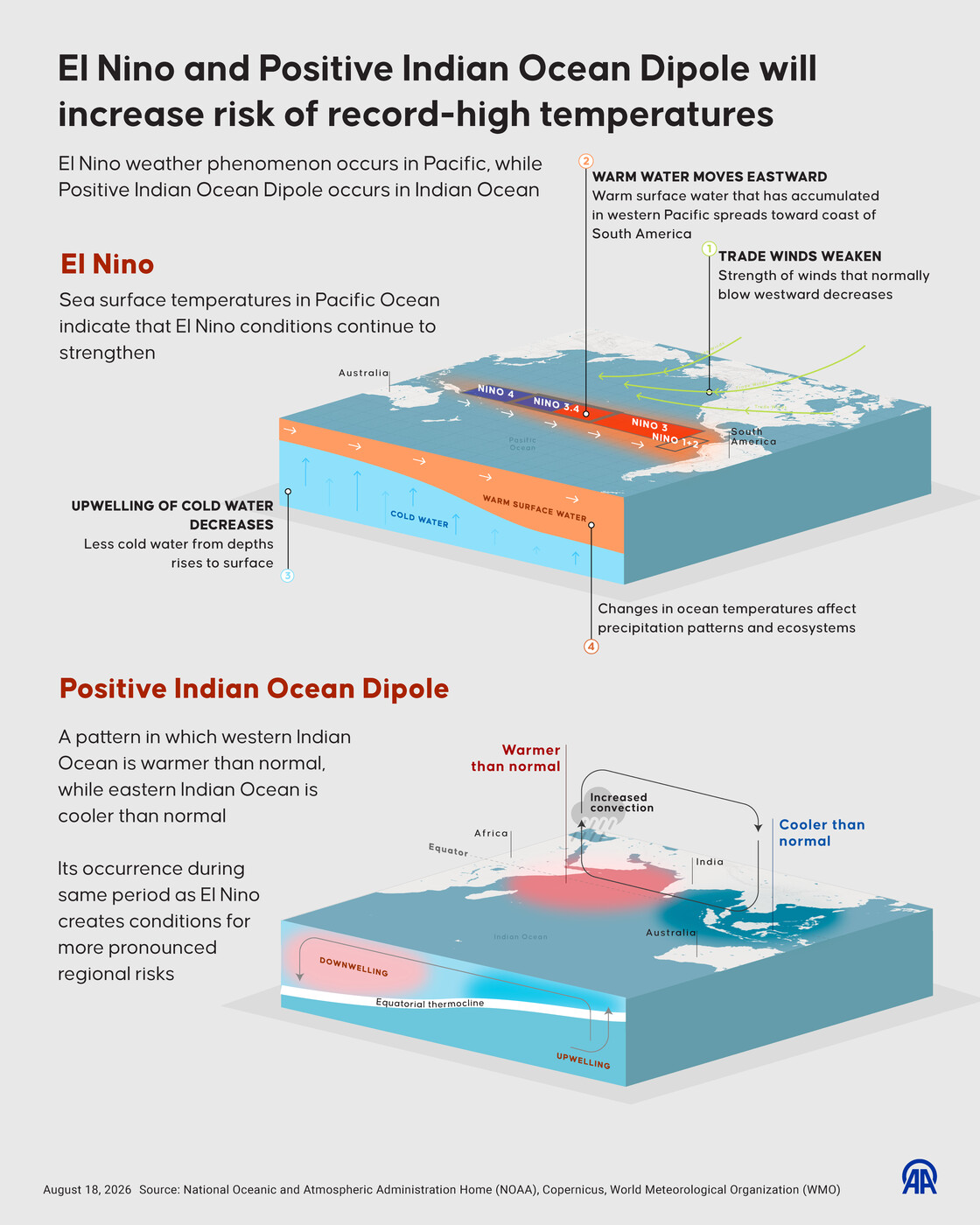


El Nino is expected to peak in late fall or early winter, with about a 70% chance of becoming the strongest event on record since 1950, according to the US National Oceanic and Atmospheric Administration (NOAA).
El Nino conditions are continuing to intensify rapidly, according to a CNN report based on the US agency's latest forecast.
The forecast indicates that the phenomenon is heading toward “record-breaking” strength, with its peak expected in late fall or early winter.
NOAA estimates the event will surpass the “Super El Nino” of 1982-83.
Experts warn that the effects of global warming could combine with El Nino to intensify heat waves and the severity of natural disasters.
Because of the expected strength of the event, 2027 is considered highly likely to become the hottest year on record.
Experts also say 2026 could potentially break the same record.
El Nino is a weather pattern in the Pacific Ocean that causes temperatures to rise, particularly in coastal regions and across much of the world.
La Nina, considered the opposite phase, is associated with cooler conditions globally.
Periods between El Nino and La Nina are considered neutral phases, when more typical or naturally occurring weather patterns prevail.