Yasin Gungor
17 November 2026•Update: 17 November 2026
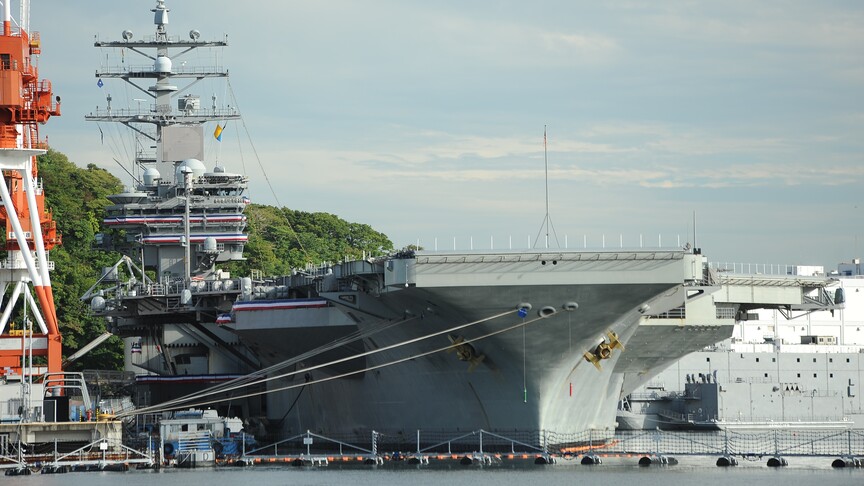
The US Navy increased its aircraft carrier presence in the Middle East to three strike groups on Sunday following the arrival of the USS Theodore Roosevelt, reinforcing Washington’s naval power in the region amid the ongoing Iran war.
US Central Command (CENTCOM), which oversees military operations across the Middle East, said Monday that the warship transited the Indian Ocean on Sunday after departing Singapore earlier this month and passing through the Strait of Malacca.
The arrival marks the second time in 2026 that Washington has concentrated three aircraft carrier strike groups in the region, following an earlier buildup at the height of the conflict in April. Before this year, the US military last assembled a comparable naval force in the Middle East during the 2003 invasion of Iraq.
With the reinforcement, roughly 53,000 US troops are stationed in the Middle East, while the Navy’s flotilla in the region now includes three aircraft carriers, 13 destroyers, two cruisers and a littoral combat ship, with two additional destroyers in the Red Sea, according to military figures and media reports.
Anatomy of 3 carrier strike groups
All three vessels are Nimitz-class nuclear-powered supercarriers measuring approximately 333 meters (1,092 feet) in length. Each has a ship’s crew of roughly 2,800 personnel, rising to about 5,000 when its embarked air wing and staff are included. Their flight decks can accommodate up to 90 aircraft.
Built by Northrop Grumman in Virginia and in active service for 40 years, the USS Theodore Roosevelt serves as the flagship of Carrier Strike Group 9, homeported at Naval Air Station North Island in San Diego, California. After beginning its deployment on Sept. 27, the carrier arrived with Carrier Air Wing 11, which fields F/A-18E/F Super Hornets, F-35C Lightning II stealth fighters, EA-18G Growler electronic attack jets, E-2D Advanced Hawkeye early-warning aircraft, CMV-22B Ospreys and MH-60 Seahawk helicopters, alongside the guided-missile cruiser USS Chosin and destroyers USS Paul Hamilton and USS Decatur.
The USS George H.W. Bush, the 10th Nimitz-class supercarrier, has operated primarily in the Arabian Sea on an extended deployment since April as part of Carrier Strike Group 10 with Carrier Air Wing 7. Displacing more than 100,000 tons, the vessel is named after the 41st US president.
Operating alongside it in the Arabian Sea since August is the USS George Washington, the sixth Nimitz-class carrier, which is normally forward-deployed to Fleet Activities Yokosuka in Japan. The carrier deploys with Carrier Air Wing 5 and operates alongside guided-missile destroyers in the region, including the USS Shoup and USS Ross.
Whether all three carriers will remain in the Middle East long-term or whether the USS Theodore Roosevelt will relieve the USS George Washington remains unconfirmed. The exact duration of the three-carrier overlap has not been publicly disclosed.
Earlier in 2026, the USS Abraham Lincoln and USS Gerald R. Ford operated in the region during the opening phases of the conflict and the April buildup before rotating out, with the Lincoln completing a 321-day deployment in October and the Ford setting a post-Vietnam War record of 326 days at sea after being redirected from Caribbean operations.
Strategic mission and diplomatic deadlock
The three-carrier concentration supports Washington’s military posture in the Iran war, which began with coordinated US-Israeli strikes in late February.
Primary missions include enforcing a maritime blockade on Iranian shipping that has curtailed oil exports, maintaining strike and electronic warfare options, and protecting navigation in the Strait of Hormuz, where commercial traffic remains heavily disrupted amid ongoing attacks, mine threats and the US naval blockade.
The naval deployment runs parallel to broader US pressure on Tehran, including the establishment of Task Force Iron Gate, a new CENTCOM initiative targeting Iran’s movement of weapons systems and sanctioned materials through land routes and the Caspian Sea.
As peace negotiations remain stalled, US President Donald Trump recently removed Vice President JD Vance from talks and declared on his social media platform Truth Social that Washington no longer needs an agreement with Iran, while warning that American forces remain ready if required.
Iranian Foreign Minister Abbas Araghchi, speaking Monday at a regional meeting in Islamabad, accused the US of choosing aggression, threats, targeted assassinations, economic pressure and a blockade in violation of international law and the UN Charter.
Despite the expanded force posture, the US military rejected an Israeli media report alleging preparations to resume large-scale operations against Iran, dismissing claims of changes to its regional force posture as “pure speculation.”