Global markets traded mixed on Tuesday amid developments in the Middle East, oil prices and bond market movements, while all eyes turned to US gross domestic product (GDP) and core Personal Consumption Expenditures (PCE) data to be released on Wednesday.
The US 10-year Treasury yield hit its highest level since 2007 at 5.3%, settling at 5.24% on Wednesday. Growing expectations that increased artificial intelligence (AI) spending will drive the US economy contributed to the rise.
The 30-year yield rose to a level unseen since 2002 at 5.62% and retreated to 5.56% at the same time.
The two-year yield rose to its highest level since May 2024 at 4.97% on Tuesday before settling at 4.9% on Wednesday.
Central banks, especially the Fed, may have to accelerate their tightening process amid rising oil prices, causing selling pressure in the bond market.
Money markets are expecting a series of rate hikes from the Fed throughout the year amid mounting concerns over persistent inflation, government spending and growing corporate debt to finance AI investments.
November-delivery Brent crude oil climbed 0.5% to $103.1 a barrel after US President Donald Trump denied reports that he was prepared to take a step to ease sanctions on Iran.
Mohsen Rezaei, secretary of the Iranian Supreme National Security Council, said Trump has found himself in a “dilemma” in which he can “neither negotiate nor fight” during a meeting with the Azerbaijani deputy prime minister in Tehran.
Trump hosted AI leaders at the White House, with senior executives from Meta, Alphabet, Microsoft, Nvidia, Tesla, AMD, Anthropic and OpenAI attending. The president called the meeting productive.
Meanwhile, Fed board member Michael Barr said risks to achieving the inflation target increased and risks related to the labor market eased, urging additional policy adjustments to manage inflation and employment risks in a more balanced way.
New York Fed President John Williams said there was no sense of urgency after this month’s policy decision, while Chicago Fed President Austan Goolsbee emphasized the danger of inflation remaining above the 2% target for five and a half years.
The US Dollar Index traded just above its previous close at 101.5, while gold was down 0.1% at $4,180 per ounce on Wednesday.
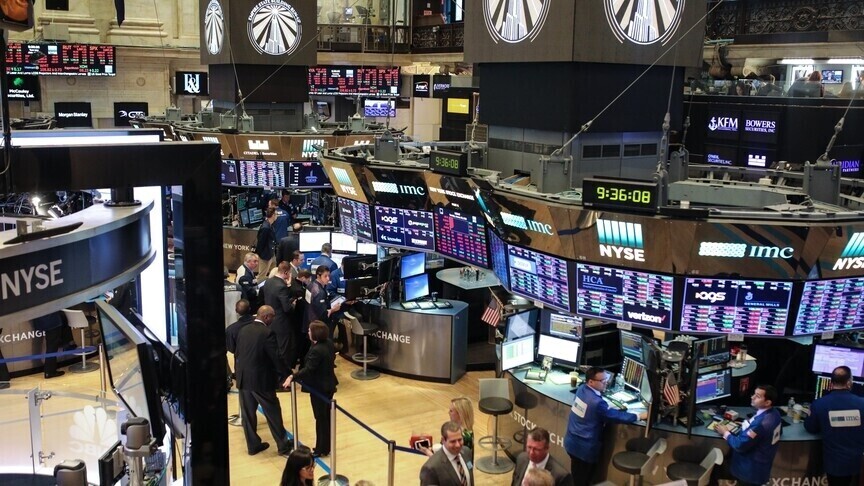
The New York Stock Exchange ended Tuesday lower as bond yields rose, while the Conference Board’s consumer confidence fell to 81.9 this month, below estimates.
The number of JOLTS job openings dropped to 7.079 million in August, also below expectations.
The Dow Jones Industrial Average fell 0.26%, the S&P 500 declined 0.17%, and the Nasdaq was down 0.09% on Tuesday. American indexes opened Wednesday on a positive note.
Meanwhile, European stock markets traded mixed amid geopolitical tensions.
The eurozone’s economic confidence fell 0.5 points month-on-month to 97.9 in September, while the bloc’s consumer confidence declined from minus 15.5 to minus 16.5 points at the same time.
Germany’s public debt hit €2.7 trillion ($3.1 trillion) in the second quarter due to infrastructure, climate and defense spending despite signs of recovery.
EU Energy and Housing Commissioner Dan Jorgensen said the union paid more than €100 billion ($113.5 billion) in additional costs for the same volume of oil and natural gas this year, emphasizing the need to reduce dependence on fossil fuel imports.
Expectations of new tax hikes in the French budget led to a decline in the country’s stock market, which was already under pressure due to debt issues and political deadlock ahead of next year’s presidential election.
The likelihood of tighter Fed policy and rising energy prices in Europe caused the euro/US dollar exchange rate to drop to its lowest level since May 2025 at 1.1312.
Germany's DAX 40 rose 0.1% and Italy's FTSE MIB 30 gained 0.09%, while France's CAC 40 dropped 0.53% and the UK's FTSE 100 fell 0.45% on Tuesday. European indexes opened Wednesday on a mixed trend.
Near Wednesday’s close, Asian equity markets traded mixed as investors remained cautious ahead of US data releases.
Beijing announced new support policies to limit the economic slowdown and said it would assess measures to stabilize its real estate market.
The People’s Bank of China (PBOC) cut its one-year lending rate for three policy banks by 25 basis points to support the real economy.
China’s manufacturing Purchasing Managers’ Index (PMI) rose from 49.9 to 50.1 in September, returning to growth, led by improving weather conditions that allowed factories to resume operations and increased AI investments.
Weak domestic demand and the prolonged stagnation in the Chinese real estate market pressured household and business confidence, while the country focused on exports and industrial production to support growth.
Japan’s retail sales dropped 1.2% on a monthly basis in August, defying estimates, while rising 2.7% year-on-year, below estimates.
Near the close of trading, Japan’s Nikkei 225 rose 2.1% and China's Shanghai Composite climbed 0.1%, while South Korea’s Kospi fell 0.2% and Hong Kong's Hang Seng traded flat.