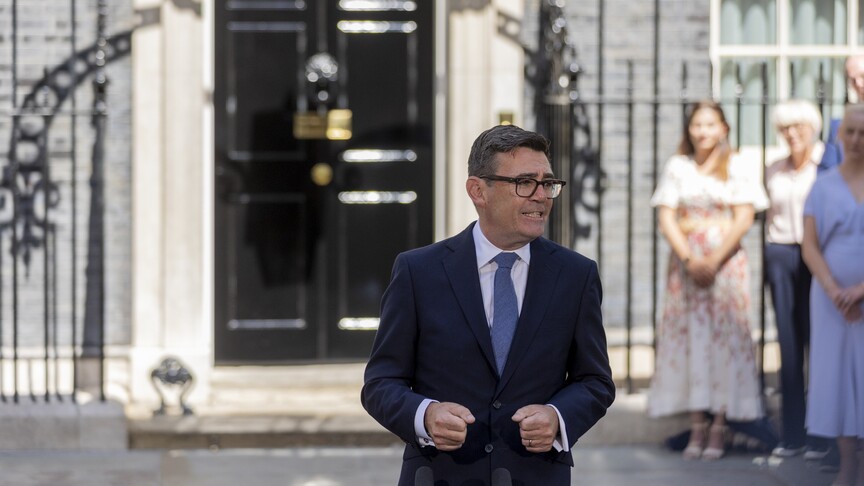
- Experts say tackling the cost of living, reviving weak growth, and restoring the UK's strained public finances remain Burnham's top challenges
- The biggest challenge is the economy – how to get sustainable growth – and the public finances – how to bring down public debt without sacrificing social priorities,' Patrick Diamond, professor of public policy at Queen Mary University of London, tells Anadolu
- Politically, Burnham must work quickly to restore trust and deliver visible, short‑term improvements while sequencing longer‑term industrial and skills investments,' says Amelia Hadfield, head of politics department at University of Surrey
British Prime Minister Andy Burnham faces serious economic challenges a month into his premiership, with experts warning that tackling the cost of living, reviving weak growth, and restoring the country’s strained public finances will be key to delivering on his domestic agenda.
It has been a month since Burnham officially became prime minister on July 17, with his pledges focusing on cost-of-living relief, devolving power from Westminster, and bringing essential services under public control.
However, experts have warned that obstacles such as post-Brexit economic challenges, as well as the complex domestic agenda he inherited, could make it difficult for him to deliver on his goals.
In an interview with Anadolu, Patrick Diamond, professor of public policy at Queen Mary University of London, said that bringing down the cost of living by cutting energy bills and the price of public transport is the pressing factor for Burnham.
"The biggest challenge is the economy – how to get sustainable growth – and the public finances – how to bring down public debt without sacrificing social priorities," he noted.
Reiterating the economy as the biggest obstacle for the new premier, Diamond underlined that post-Brexit, the UK economy is weak and there has been a marked deterioration in the UK’s fiscal position.
He went on to say that the economy is not growing above 1.5%, which is "not enough to support the welfare state and public services."
"Any government in Britain is constrained in what it can do due to that underlying economic weakness," he added.
For Diamond, the cost of living is a good place to start for Burnham as an immediate priority to build public confidence.
However, he said the government has to show that it can also improve competitiveness and make the private sector economy work more efficiently by reducing red tape, and making it easier to start and grow a business.
"It is not enough to redistribute the cake more fairly – it is essential to also make the cake bigger," said Diamond.
'Burnham must work quickly to restore trust'
Amelia Hadfield, head of the politics department at the University of Surrey, said that Burnham inherits a "complex, compound domestic agenda," from persistent regional inequality to stalled productivity that demand tangible place‑based wins.
For her, acute cost‑of‑living pressures and public service backlogs such as health, social care, and housing could undermine public confidence, which could make things more difficult for Burnham.
She also stressed energy security and the need to accelerate clean electrification while protecting industry are also among challenges for Burnham.
"Politically, Burnham must work quickly to restore trust and deliver visible, short‑term improvements while sequencing longer‑term industrial and skills investments," Hadfield noted.
She went on to say that Burnham will need to "balance urgency with the institutional reform" needed to sustain them.
Hadfield suggested that devolution and "place-based" initiatives, skills and employment, and kickstarting infrastructure acceleration by committing streamlined planning windows should be prioritized by the new government during the first 100 days.
However, she warned that the current situation of public finance and economic pressure may affect the prime minister's plans.
"Burnham’s delivery goals may likely collide with constrained public finances and competing fiscal pressures, limiting the speed and scale of place deals," she added.
Hadfield noted that "Whitehall fragmentation" and "historically siloed departmental incentives" and slow procurement/legal processes will impede rapid rollout.
She underlined that powerful sectoral lobbies and incumbent interests could block regulatory reforms, adding that socially, very real public fatigue over reform and distributional concerns -- especially in communities dependent on legacy industries -- risks backlash.
"Finally, external shocks (energy price volatility, global economic slowdown) could divert attention and funding, making sequencing, credible commitments, and strong delivery institutions essential," she added.