
Dr. Can Kasapoglu is a senior defense analyst at the Hudson Institute and teaches at the NATO Defense College, where he retains an honorary ancien title.
For years, the central puzzle of unmanned aviation was how robotic aircraft might assist manned fighters.
In the age of emerging and disruptive technologies, with skyrocketing robotics and AI trends, that very debate, once seemed like sci-fi, might itself become obsolete. Artificial intelligence, autonomous flight and high-end sensors are pushing robotic warfare in the skies beyond merely supporting roles.
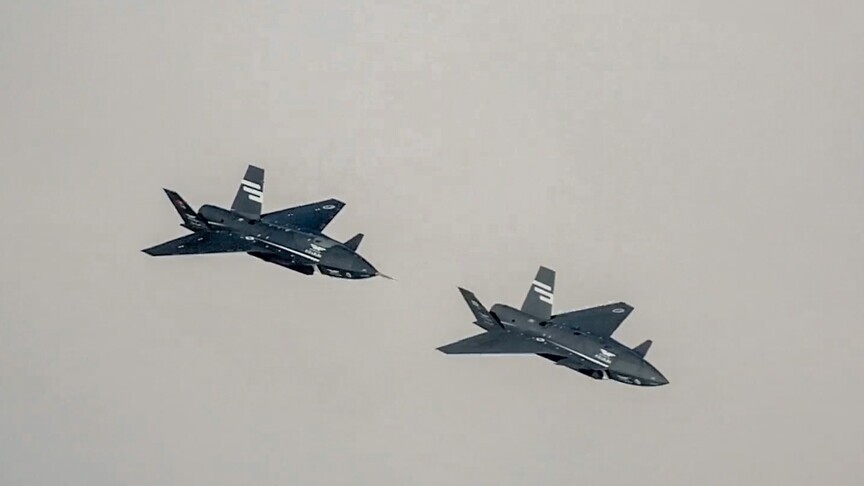
Some unmanned fighters may eventually challenge 4th and 4.5th generation fighters, while their place in 5th and 6th-generation air warfare remains to be seen in the 2030s. Kizilelma has entered service at precisely this technological crossroads. Its design philosophy presages a fundamental shift in the air-warfare paradigm.
In 2020, the US Defense Advanced Research Projects Agency (DARPA) conducted its AlphaDogfight Trials. An artificial intelligence algorithm defeated an experienced US Air Force F-16 pilot in five simulated engagements. These were restricted, gun-based dogfights, hardly the full complexity of modern air warfare. Nevertheless, the results exposed an uncomfortable reality: human experience and instinct, long considered indispensable in aerial combat, could be challenged by smart and agile machines capable of calculating engagement geometry and tactical maneuvers at extraordinary speed.
DARPA subsequently brought the experiments into the skies with real platforms. Under its Air Combat Evolution program, the AI-controlled X-62A VISTA, an experimental F-16 derivative, conducted combat maneuvers against human-piloted F-16s in 2023 and 2024.
Europe followed suit. In June 2025, Sweden's Saab and Germany's Helsing tested the latter's Centaur artificial intelligence system aboard a Gripen E fighter. Under Project Beyond, the aircraft flew against a human-piloted Gripen D in beyond-visual-range scenarios involving autonomous maneuvering, sensor processing, and target tracking.
The experiments point to a transformation that goes beyond replacing pilots with algorithms. The real revolution lies in combining sensors, weapons, autonomous decision-making, and mission coordination within a new warfare architecture.
Kizilelma's military significance begins with its sophisticated sensor suite. The unmanned combat aircraft incorporates three high-end ASELSAN systems: the MURAD active electronically scanned array (AESA) radar, the KARAT infrared search-and-track (IRST) system, and the TOYGUN electro-optical targeting system (EOTS).
MURAD provides multiple-target tracking and beyond-visual-range missile guidance. KARAT detects infrared signatures without active radar emissions. TOYGUN adds high-resolution imagery, automatic target recognition, and laser targeting. During April flight testing, KARAT reportedly detected a passenger aircraft from approximately 68 miles away (109 kilometers).
The architecture's importance lies in its potential to feed artificial intelligence with data gathered through different sensing methods. Radar, infrared detection, and electro-optical targeting can contribute to a common tactical picture. Such integration promises greater situational awareness and provides the technological foundation for independent combat missions.
Here lies the essential distinction that sets a precedent for the rest of NATO: Baykar never envisioned Kizilelma simply as another loyal wingman. Its collaboration with ASELSAN reveals ambitions extending beyond an expendable aircraft carrying additional missiles for a manned fighter. Kizilelma is being developed as a combat system possessing its own eyes, weapons, and increasingly sophisticated decision-making capabilities.
Military technology also cannot escape the political dimension. The capture of an Indian fighter pilot in 2019 in the air skirmish with the Pakistanis, and the successful but high-risk operation to rescue American F-15E aircrew following the aircraft's loss over Iran in April, illustrated how tactical setbacks in manned military aviation can generate strategic liabilities. Robotic air warfare offers a whole new ballgame to the risk assessment.
Baykar envisions five Kizilelma variants: A, B, CA, CB and D. The jumpstart batches reflect another interesting geopolitical trend: Ukrainian-Turkish defense cooperation amid the ongoing Russian invasion. At the outset of the Russian columns pouring into Kyiv, Baykar's TB-2 drones preyed on the Russian heavy armor and logistics. Now, Ukrainian aerial engine technology powers the Turkish unmanned combat aircraft. The initial platform relies on Ukraine's AI-25TLT turbofan. Later configurations employ the afterburning AI-322F, while supersonic performance remains a longer-term ambition. Türkiye is also pursuing indigenous propulsion through TEI's TF6000 and TF10000 programs.
Ukraine has already cut deals with France and Sweden for modernizing its air force. Nonetheless, seeing Kizilelma squadrons parked on the Ukrainian air bases in the 2030s would not be surprising.
Another critical plan is the Kizilelma line for the navy: the CA variant. Together with Türkiye's MUGEM aircraft carrier project, it could eventually extend unmanned fighter operations into robotic airwings for naval aviation. The Turkish amphibious assault vessel, TCG Anadolu, already fielded Baykar's TB-3 drones in NATO exercises. Exploiting these capabilities will require a specialized cadre of drone pilots, eventually including naval aviation.
Kizilelma's expanding weapons pack includes the Gokdogan beyond-visual-range air-to-air missile, TOLUN, TEBER-82, LGK-82 and JET-230 aeroballistic missile. Internal weapons bays help preserve its low-observable characteristics.
Baykar's announcement that it had delivered the first three aircraft to Türkiye's "security forces" is also intriguing. The company did not specify which institution received them. Ukraine provides an instructive precedent. Its security service, the SBU, demonstrated the operational reach of robotic warfare through Operation Spiderweb and strikes against the Crimean Bridge. Military intelligence, the GUR, meanwhile, pioneered new forms of unmanned naval combat. Whether the Turkish security service might eventually operate Kizilelma remains speculation. Nevertheless, as Ukraine showcased, robotic warfare is already challenging traditional institutional boundaries between military operations and covert wartime activities.
The economic calculation is similarly consequential. Production scale, maintenance requirements and lifecycle costs will determine affordability. Indonesia's 12-aircraft agreement nevertheless indicates substantial export potential, including in the Gulf, Azerbaijan and NATO weapons markets.
For NATO, high-intensity warfare increasingly raises concerns about combat mass, distributed sensing, resilience and industrial endurance. Kizilelma could help meet these demands. Participation in NATO exercises and eventual adoption by allied militaries would reinforce collective defense while introducing a new approach to air warfare in modern conflict.
Overall, Kizilelma opens a new chapter in military aviation. In decades, its maturing technological DNA will likely enable hyperwar in the skies.
*Opinions expressed in this article are the author's own and do not necessarily reflect the editorial policy of Anadolu.
news_share_descriptionsubscription_contact

contact_the_ombudsman
is_there_an_error_in_this_story