Trump in Beijing for summit with Xi amid Iran war
1st state visit to China by a sitting US president in 9 years; Iran, Taiwan, trade, tech and tariffs high on agenda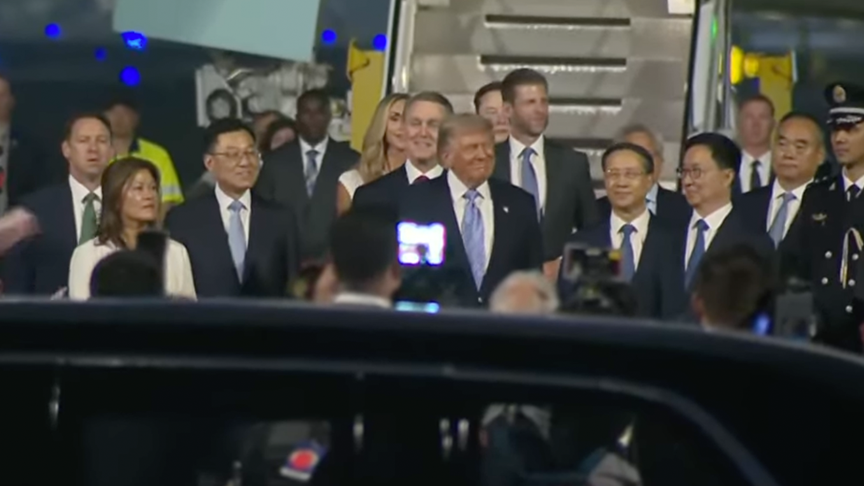
US President Donald Trump on Wednesday kicked off a three-day state visit to China amid the ongoing war in Iran.
Trump was welcomed by a guard of honor after Air Force One landed at Beijing Capital International Airport.
Vice President Han Zheng received him at the airport, where dozens of youths and a military band were also present.
The visit marks the first by a sitting US president to China in nine years.
Trump headed to his hotel from the airport, where the landed at 1150GMT and has no official engagement for rest of the day.
On Thursday, Chinese President Xi Jinping will host Trump for summit-level talks at the Great Hall of the People.
The Middle East conflict, Taiwan as well as trade and tariffs remain high on the agenda.
Trump earlier said he would bring up arms sales to Taiwan as well as the case of imprisoned Hong Kong media tycoon Jimmy Lai during the meeting, while Beijing has said the two leaders would discuss "major issues concerning China-US relations, world peace and development.”
Trump is accompanied by Secretary of State Marco Rubio and Defense Secretary Pete Hegseth, along with numerous CEOs of major US companies, including Nvidia’s Jensen Huang and Tesla’s Elon Musk.
US Treasury Secretary Scott Bessent will also be joining Trump in Beijing after holding trade talks with Chinese Vice Premier He Lifeng in South Korea.
First lady Melania Trump is not accompanying the US president, unlike 2017 when the two were hosted by Xi and Chinese First Lady Peng Liyuan.
The anticipated visit comes amid the Middle East conflict, triggered after the US and Israel launched strikes against Iran on Feb. 28, prompting retaliation against Israel and US allies in the Gulf, along with the closure of the Strait of Hormuz.
A prolonged ceasefire is currently in effect.
China has reiterated calls for dialogue in the region, while Washington has accused Beijing of supporting Iran’s military and economic capabilities.
Relations between Washington and Beijing have also become increasingly strained during Trump’s second term due to disputes over tariffs, technology restrictions, and China’s tightening control over rare earth elements.