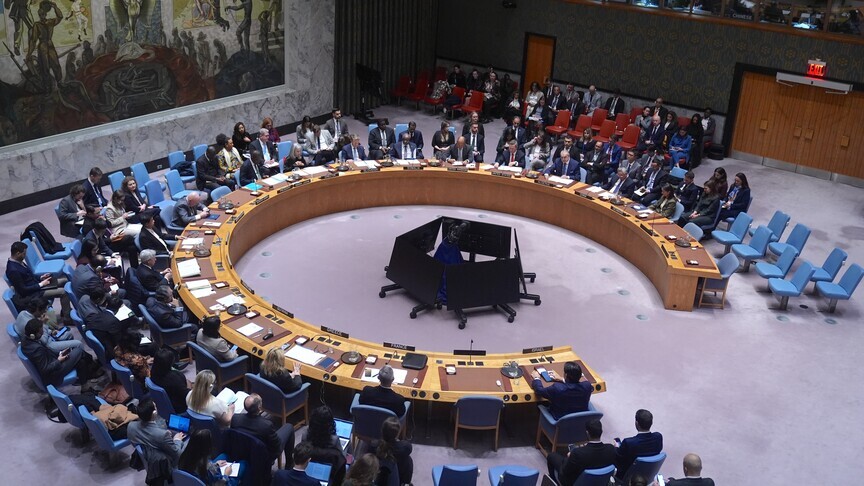
The UN Security Council's growing dysfunction and geopolitical rivalries are undermining international law and weakening efforts to resolve conflicts, International Crisis Group President Comfort Ero told Anadolu in an interview, warning that the body's credibility and legitimacy are increasingly at stake.
Ero said tensions among major powers, mutual distrust and the inability to hold powerful countries accountable were limiting the UN's capacity to maintain international peace and security at a time when conflicts are becoming increasingly interconnected.
"The United Nations is only as good as its member states allow it to be," she said.
"And at the heart of that is the Security Council. And where the Security Council is dysfunctional, where you've got geopolitical competition and tension, mutual suspicion, and an inability to deal with these critical conflicts, then it becomes very difficult to see a resolution of the conflict as well."
She stressed that while the UN could continue providing humanitarian assistance, health care and aid delivery, its ability to address the underlying political causes of conflicts depended on the willingness of governments to cooperate.
"But if the member states don't focus on the political issues around these conflicts, then the role and the performance of the UN becomes limited as well," she said.
Ero warned that rising military competition and the growing overlap between regional conflicts were creating additional challenges for international peace and security.
She said countries were increasingly reassessing their security guarantees, strengthening their defense capabilities and reconsidering their dependence on traditional allies.
"We're seeing countries more and more building up their defense, securing their defense architecture. They are trying to review their own security guarantees," she said.
Ero also expressed concern about the risk of nuclear proliferation and the weakening of international arms control arrangements.
"I think one of the concerns for all of us is around nuclear proliferation. Arms control also is looking very fragile today," she said.
Pointing to the conflict involving Iran and tensions around the Strait of Hormuz alongside the war in Sudan and instability across the Horn of Africa, she warned that conflicts were increasingly overlapping and becoming internationalized.
Ero warned that the growing reliance on military power was making it increasingly difficult for international institutions to maintain peace and enforce international law.
"I think one of the big challenges that we see today more and more is how you can cause peace in an era of sort of hard power," she said.
She argued that the Security Council's divisions had created an environment in which some governments believed they could act without facing meaningful consequences.
"One of the challenges that we face today is how we restore international law," she said, warning that some leaders believe "they can get away with things, that they can undermine core principles and norms, that there are no longer any constraints."
She argued that efforts to sanction governments or exert political pressure had become increasingly difficult because of the lack of international leverage to discourage violations.
The challenge was particularly significant when permanent members of the Security Council were themselves involved in actions that raised questions about compliance with international law, she said.
Referring to Russia's invasion of Ukraine and US military actions against Iran and Venezuela, Ero questioned how the international system could constrain countries that hold veto power within the body responsible for maintaining international peace and security.
"So there is a question mark about how you can constrain the P5 members, or at least these two countries that you mentioned. But that is the test. And that really is about the credibility and the legitimacy of the Security Council," she said.
Ero warned that countries could increasingly pursue alternative security arrangements if the Security Council could no longer effectively carry out its mandate.
"If it can no longer play that international peace and security role that it is mandated to do, then others will seek other venues. You will see more coalitions forming," she said.
Ero also addressed longstanding demands to reform the Security Council, particularly the veto powers held by its five permanent members -- the US, Russia, China, Britain and France.
She expressed skepticism that the permanent members would willingly relinquish their veto privileges.
"The one thing that will bind all the Permanent Five who have the power of the veto, this is the one thing that will keep them all on the same page, that they'll do everything to protect their veto," she said.
However, Ero distinguished between how permanent members exercise that power, pointing to Britain and France as examples of countries that have shown restraint in using their vetoes.
She contrasted their approach with the challenges posed by the other three permanent members -- the US, China and Russia.
Ero stressed that the Security Council's non-permanent members could cooperate to influence the five permanent members, particularly on conflicts such as Sudan and Gaza.
"The other key issue is how the other members, non-permanent members of the Security Council, how they operate, how they work together in cooperation and in solidarity to try to nudge the P5 in the right direction," she said.
She also pointed to debates surrounding the US-backed Board of Peace for Gaza, arguing that its need for Security Council recognition demonstrated the continuing importance of the UN system despite its limitations.
"Even the United States in the end realized that even the Board of Peace needed some kind of endorsement, needed some kind of recognition at the level of the Security Council," she said.
Ero called for a stronger role for the UN General Assembly in scrutinizing powerful countries accused of undermining the UN Charter, particularly when divisions within the Security Council prevent action.
Following Russia's 2022 invasion of Ukraine, Moscow used its veto to block a Security Council resolution condemning the attack. The General Assembly subsequently adopted a resolution demanding the withdrawal of Russian forces, although the measure did not bring an end to the invasion.
While General Assembly resolutions generally lack the binding force of Security Council decisions, they can provide a platform for member states to challenge violations of international law and exert political pressure.
Ero argued that UN member states should make greater use of that role to scrutinize powerful countries and demand accountability.
"So it's really important that the rest of the body of the UN and the member states exercise their own power, exercise their own right to ask these questions, to hold these countries accountable, and to provide oversight. They can do that," she said.
"The question is why more and more and more of them are not using the General Assembly to put a spotlight and a scrutiny when any member state, especially a P5, undermines the Charter of the UN in this way as well," she added.
news_share_descriptionsubscription_contact

contact_the_ombudsman
is_there_an_error_in_this_story